


Europe’s petchem plants close, assets change hands: How far has restructuring progressed?
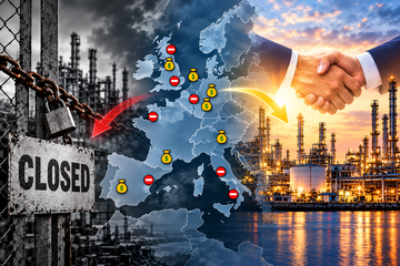
Closed or closing: Close to 11 million tons/year affected
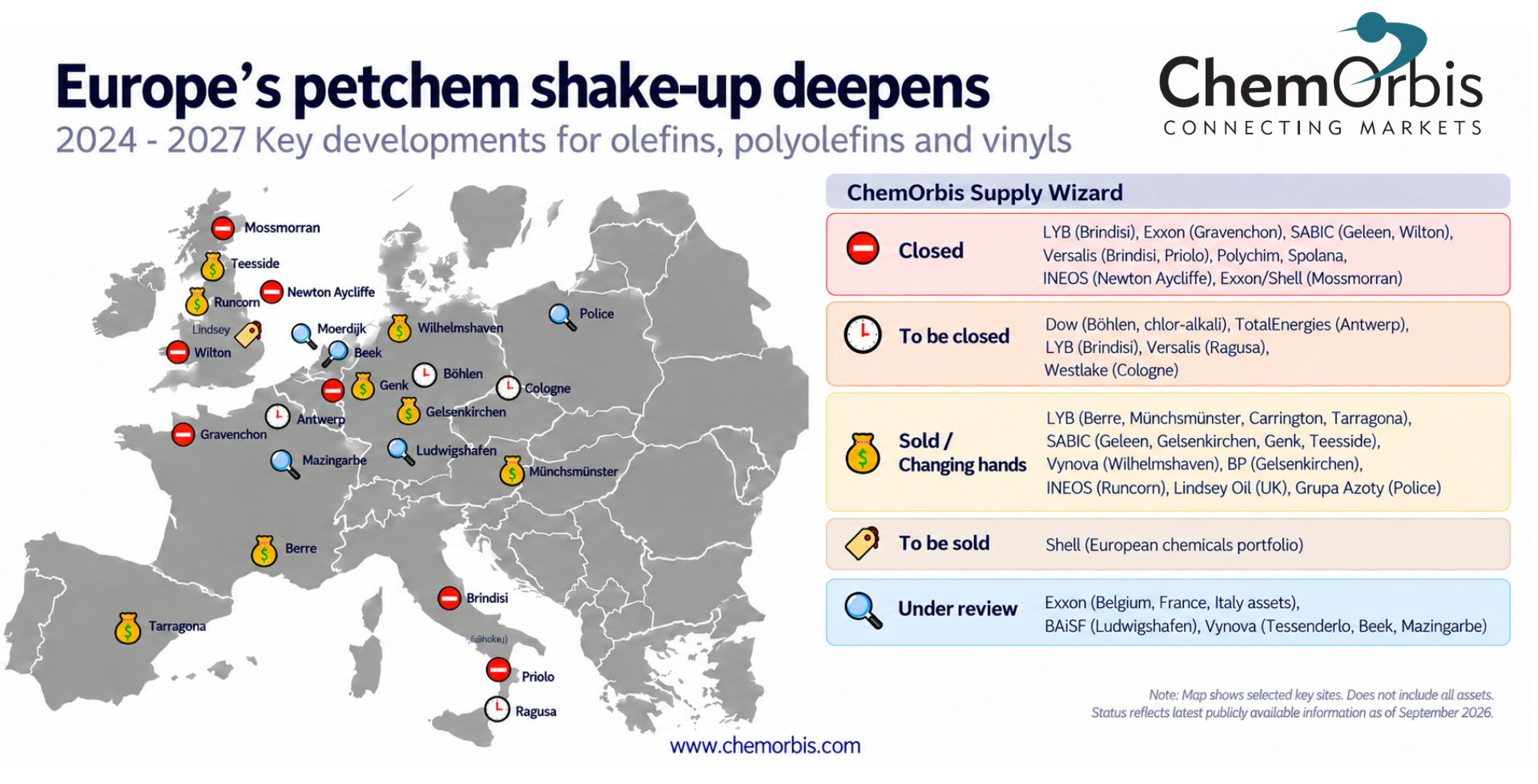
The most visible part of Europe’s restructuring remains outright capacity rationalization. Based on ChemOrbis Supply Wizard data, close to 11 million tons/year of combined nameplate capacity across ethylene, propylene, PP, PE and the chlor-vinyls chain has been closed, idled or earmarked for closure since 2024.
| Capacity closures by product: ChemOrbis Supply Wizard | |
|---|---|
| Product | Capacity affected |
| Ethylene | 5.18 million t/y |
| Propylene | 2.12 million t/y |
| PP | 965,000 t/y |
| PE | 535,000 t/y |
| S-PVC | 675,000 t/y |
| VCM | 629,000 t/y |
| EDC | 825,000 t/y |
Olefins have borne the brunt of the reductions, reflecting the pressure on Europe’s ageing and predominantly naphtha-based cracker fleet. The closure wave has included major assets belonging to SABIC, ExxonMobil, Versalis and LyondellBasell, while further shutdowns at Dow, TotalEnergies and Versalis are already scheduled through 2027.
The latest addition came on September 29, when Westlake announced that it will permanently close its Cologne PVC plant in the first quarter of 2027. The producer cited weak demand, elevated energy costs and increased import pressure, noting that the site faces higher costs than its other European PVC facilities due to its smaller scale and higher logistics burden.
Yet the Cologne closure does not represent a broader retreat by Westlake from European PVC. Earlier this year, the company acquired Vynova’s Wilhelmshaven operations, including around 380,000 tons/year of PVC capacity.
The two moves provide a clear example of how Europe’s restructuring is evolving: less competitive capacity is being removed while larger or better-positioned assets are retained within increasingly consolidated production networks.
Closures tell only part of the story. An increasingly important part of Europe’s restructuring involves production assets changing owners rather than disappearing.
| Asset Transfers: ChemOrbis Supply Wizard | ||
|---|---|---|
| Assets | New owner | Latest status |
| LyondellBasell European portfolio | AEQUITA / Velogy | Completed |
| SABIC European petrochemicals | AEQUITA | EC approved Sep 3 |
| Vynova Wilhelmshaven | Westlake | Completed |
| Vynova Runcorn assets | INEOS Inovyn | Agreed / pending approvals |
| BP Gelsenkirchen | Klesch | Agreed |
| Grupa Azoty Police PDH/PP | Orlen | Preliminary agreement |
Together, completed and agreed transactions tracked by ChemOrbis Supply Wizard encompass well above 10 million tons/year of aggregate nameplate capacity across individual olefins, polyolefins and vinyls units.
One of the clearest examples is AEQUITA. The latest approval by the European Commission about the acquisition of Sabic’s European assets reinforces AEQUITA’s emergence as a major consolidator of European petrochemical assets. More broadly, these transactions show that assets considered non-core by incumbent producers are not necessarily disappearing from Europe: some are finding new owners prepared to operate them within different portfolio, integration or cost structures.
Under review: More decisions are still aheadEven after the closures and ownership changes already announced, a significant part of Europe’s restructuring map remains unresolved.
Shell: European chemicals business under strategic review / potential sale
ExxonMobil: options reviewed for remaining European chemical assets
BASF: Ludwigshafen competitiveness under continued scrutiny
Vynova: Tessenderlo, Beek and Mazingarbe seeking a buyer
Excluding Shell, whose potential divestment perimeter has not been disclosed, more than 4 million tons/year of identifiable olefins, PE and vinyls capacity remains in the under-review/potential-sale category.
 So, how far has restructuring progressed?Europe is clearly past the opening phase of its petrochemical restructuring.
The first stage - removing structurally uncompetitive capacity - is already well established, with close to 11 million tons/year affected and further closures scheduled through 2027.
The second stage - consolidating surviving assets under new ownership - is gathering momentum. Westlake’s acquisition of Wilhelmshaven followed by the planned closure of Cologne, alongside AEQUITA’s rapidly expanding European portfolio, illustrates how the process is shifting from straightforward capacity destruction towards a broader reshaping of ownership and production networks.
But the third stage is still unfolding. Major assets remain under review or up for sale, meaning the eventual size and ownership structure of Europe’s petrochemical industry has yet to take shape.
Europe’s restructuring can therefore be described as a structural reset in its middle-to-late stage: capacity rationalization is advanced, consolidation is accelerating, but the final industry landscape is not yet visible.
More free plastics news
Plastic resin (PP, LDPE, LLDPE ,HDPE, PVC, GPS; HIPS, PET, ABS) prices, polymer market trends, and more...- After Germany and the Netherlands, Vynova files for bankruptcy in Belgium: Where do its remaining European operations stand?
- Oil price plunge rattles polymer markets: Will the rally lose steam?
- Naphtha rally intensifies in Europe, Asia; Europe hits highest since March 2022
- Suez recovery gains ground, but global shipping remains far from normal
- Saudi pipeline outage compounds supply and logistics risks, fueling PP, PE rally
- S Korea’s petchem restructuring moves from talks to closures
- European natural gas, Asian LNG hit fresh highs amid Middle East tensions
- Global shipping faces persistent bottlenecks across major trade routes
- War or recovery? H1 earnings reshuffle petchem winners and losers
- Oil roller coaster in July H2 fails to derail most polymer rallies
