


European natural gas, Asian LNG hit fresh highs amid Middle East tensions
by Zehra Kırca - zkirca@chemorbis.com
by Esra Ersöz - eersoz@chemorbis.com 
Natural gas prices in Europe and spot LNG prices in Northeast Asia have climbed to their highest levels in nearly four years, well exceeding the previous war-driven peaks in mid-March and mid-July, as renewed hostilities between the US and Iran revived concerns over prolonged disruptions to energy flows through the Strait of Hormuz. The rally has brought gas markets back to levels last seen during the 2022-23 global energy crisis, while low European inventories and strong competition for LNG cargoes are adding to supply concerns.
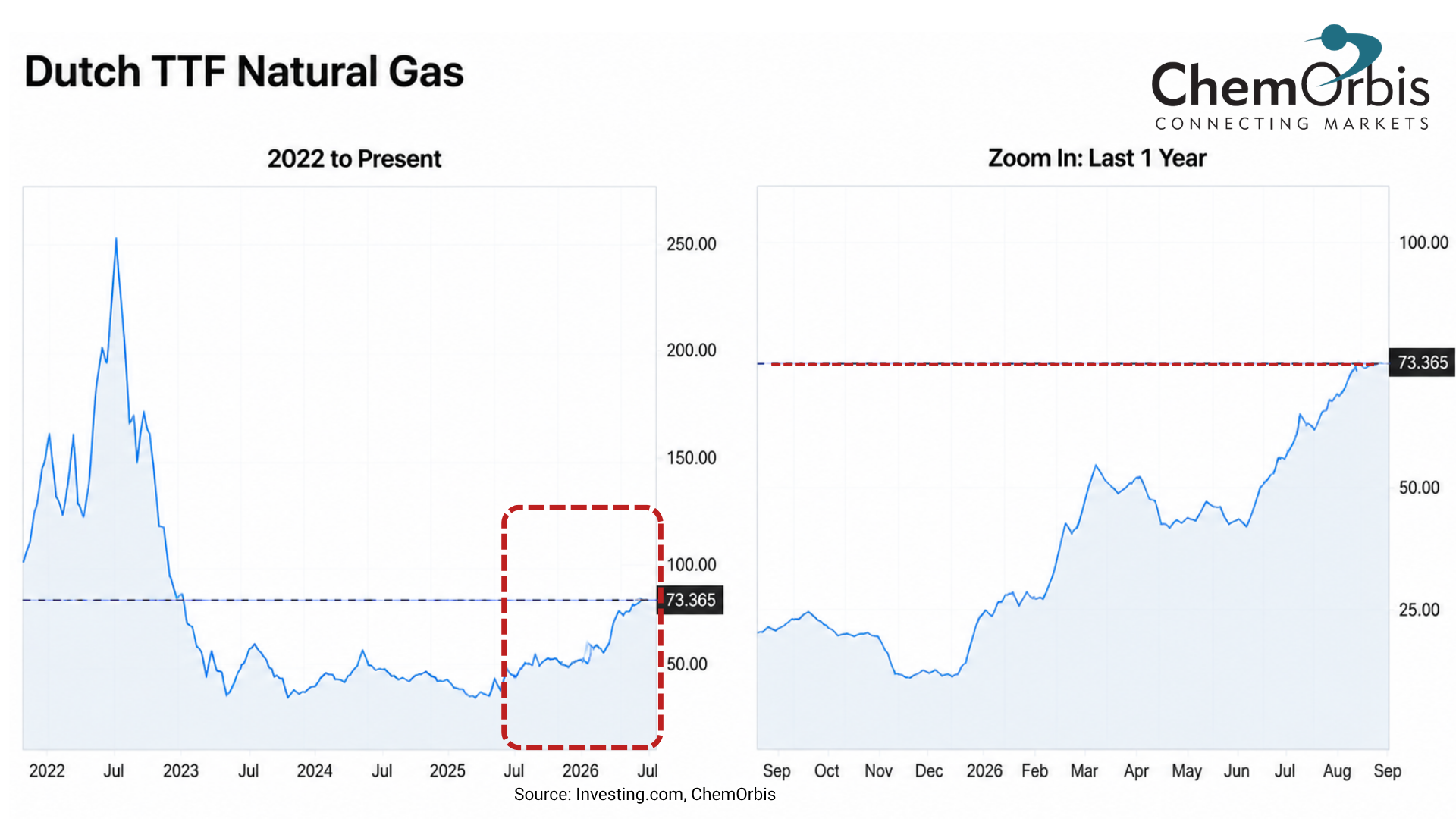
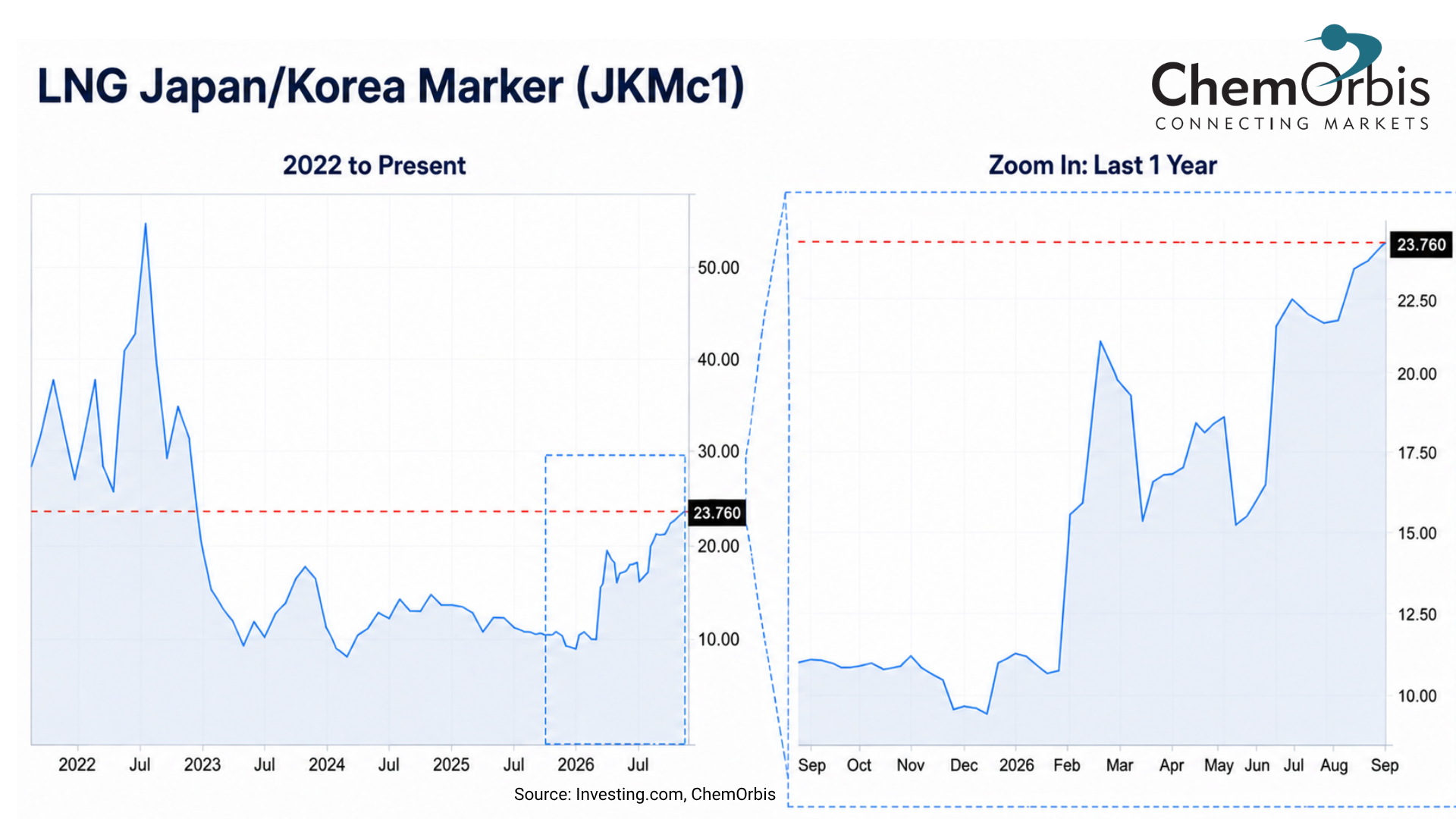
In Northeast Asia, the Platts Japan Korea Marker (JKM), the benchmark for spot LNG delivered to the region, rose to $25.908/MMBtu on September 2, its highest since December 2022, according to traders cited by Bloomberg. Meanwhile, Dutch TTF front-month futures, Europe’s benchmark natural gas contract, climbed above €75/MWh on September 2, marking their highest level since early 2023, before easing on September 3.
The last time prices were around such elevated levels was during the global energy crisis triggered by Russia’s invasion of Ukraine, when sharply reduced Russian pipeline gas supplies to Europe intensified competition between European and Asian buyers for limited LNG cargoes.
Gas prices more than double from pre-war levels
The latest rally has brought both Northeast Asian LNG and European gas prices back to levels last seen during the 2022-23 energy crisis. Before the Middle East war broke out in late February, Asian spot LNG prices were hovering at around $10-11/MMBtu, while Dutch TTF futures were trading at around €30-35/MWh.
The initial disruption to Middle Eastern energy flows sent both markets sharply higher in March. JKM climbed above $22/MMBtu, while European gas prices also surged as the effective closure of the Strait of Hormuz raised concerns over the loss of Gulf LNG supplies. Prices subsequently retreated as immediate supply fears eased, with JKM falling to around $16/MMBtu by late April and TTF dropping to around €45/MWh by late May.
The latest escalation has reversed much of that relief. JKM surged to nearly $26/MMBtu on September 2, its highest since December 2022, while TTF briefly climbed above €75/MWh, reaching its highest level since January 2023.
Both benchmarks have therefore more than doubled from their pre-war levels, underscoring the renewed risk premium triggered by prolonged Hormuz disruptions and the latest escalation in US-Iran hostilities.
Hormuz shock links European and Asian markets
The Strait of Hormuz lies at the center of the rally. Before the conflict, roughly 20% of global LNG supply passed through the waterway, with Qatar accounting for the bulk of these volumes. The disruption therefore tightened the global LNG balance simultaneously rather than affecting Europe or Asia in isolation.
The impact has also begun to reshape physical trade flows. Three LNG cargoes loaded in Qatar and the UAE were recently transferred between vessels outside Hormuz before continuing towards Asian buyers, highlighting efforts to circumvent disruptions along the key shipping route.
For Europe, the loss of Gulf LNG increases its need to compete with Asian buyers for flexible supplies, particularly from the US. The JKM-TTF spread has repeatedly shifted in Asia’s favor since the outbreak of the war, providing an incentive for flexible LNG cargoes to head east when Asian prices offer a sufficient premium.
Low European stocks, Asian demand response add to uncertainty
Europe enters the latest price spike from a particularly vulnerable position. EU gas storage facilities were around 65% full as of August 31, well below the five-year seasonal average of 82%. Additional supply cuts at Norway’s Kollsnes gas processing plant and Troll field have added to concerns as the region approaches the winter heating season.
In Asia, the response has instead been increasingly visible on the demand side. High spot LNG prices have discouraged purchases by price-sensitive buyers, with China reducing its exposure to expensive spot cargoes and relying more heavily on domestic production and pipeline gas. Pakistan has also struggled to secure affordable LNG supplies.
In Northeast Asia, the Platts Japan Korea Marker (JKM), the benchmark for spot LNG delivered to the region, rose to $25.908/MMBtu on September 2, its highest since December 2022, according to traders cited by Bloomberg. Meanwhile, Dutch TTF front-month futures, Europe’s benchmark natural gas contract, climbed above €75/MWh on September 2, marking their highest level since early 2023, before easing on September 3.
The last time prices were around such elevated levels was during the global energy crisis triggered by Russia’s invasion of Ukraine, when sharply reduced Russian pipeline gas supplies to Europe intensified competition between European and Asian buyers for limited LNG cargoes.
Gas prices more than double from pre-war levels
The latest rally has brought both Northeast Asian LNG and European gas prices back to levels last seen during the 2022-23 energy crisis. Before the Middle East war broke out in late February, Asian spot LNG prices were hovering at around $10-11/MMBtu, while Dutch TTF futures were trading at around €30-35/MWh.
The initial disruption to Middle Eastern energy flows sent both markets sharply higher in March. JKM climbed above $22/MMBtu, while European gas prices also surged as the effective closure of the Strait of Hormuz raised concerns over the loss of Gulf LNG supplies. Prices subsequently retreated as immediate supply fears eased, with JKM falling to around $16/MMBtu by late April and TTF dropping to around €45/MWh by late May.
The latest escalation has reversed much of that relief. JKM surged to nearly $26/MMBtu on September 2, its highest since December 2022, while TTF briefly climbed above €75/MWh, reaching its highest level since January 2023.
Both benchmarks have therefore more than doubled from their pre-war levels, underscoring the renewed risk premium triggered by prolonged Hormuz disruptions and the latest escalation in US-Iran hostilities.
Hormuz shock links European and Asian markets
The Strait of Hormuz lies at the center of the rally. Before the conflict, roughly 20% of global LNG supply passed through the waterway, with Qatar accounting for the bulk of these volumes. The disruption therefore tightened the global LNG balance simultaneously rather than affecting Europe or Asia in isolation.
The impact has also begun to reshape physical trade flows. Three LNG cargoes loaded in Qatar and the UAE were recently transferred between vessels outside Hormuz before continuing towards Asian buyers, highlighting efforts to circumvent disruptions along the key shipping route.
For Europe, the loss of Gulf LNG increases its need to compete with Asian buyers for flexible supplies, particularly from the US. The JKM-TTF spread has repeatedly shifted in Asia’s favor since the outbreak of the war, providing an incentive for flexible LNG cargoes to head east when Asian prices offer a sufficient premium.
Low European stocks, Asian demand response add to uncertainty
Europe enters the latest price spike from a particularly vulnerable position. EU gas storage facilities were around 65% full as of August 31, well below the five-year seasonal average of 82%. Additional supply cuts at Norway’s Kollsnes gas processing plant and Troll field have added to concerns as the region approaches the winter heating season.
In Asia, the response has instead been increasingly visible on the demand side. High spot LNG prices have discouraged purchases by price-sensitive buyers, with China reducing its exposure to expensive spot cargoes and relying more heavily on domestic production and pipeline gas. Pakistan has also struggled to secure affordable LNG supplies.
More free plastics news
Plastic resin (PP, LDPE, LLDPE ,HDPE, PVC, GPS; HIPS, PET, ABS) prices, polymer market trends, and more...- Europe’s petchem plants close, assets change hands: How far has restructuring progressed?
- Suez recovery gains ground, but global shipping remains far from normal
- Saudi pipeline outage compounds supply and logistics risks, fueling PP, PE rally
- S Korea’s petchem restructuring moves from talks to closures
- Global shipping faces persistent bottlenecks across major trade routes
- War or recovery? H1 earnings reshuffle petchem winners and losers
- Oil roller coaster in July H2 fails to derail most polymer rallies
- Dow’s €1.1 billion claim puts Europe’s ethylene cartel dispute back in focus
- Crude oil surges on renewed war premium; will it reverse the polymer slump?
- EU publishes tariff regulation, swings doors wide open to duty-free US plastics