



S Korea’s petchem restructuring moves from talks to closures
by Esra Ersöz - eersoz@chemorbis.com
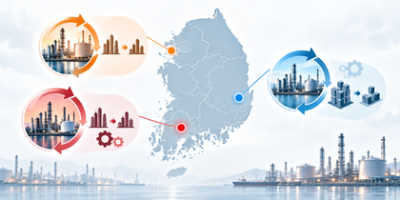
South Korea’s long-running petrochemical restructuring drive has moved from negotiations to concrete capacity rationalization, with the first major integration completed in Daesan and another government-backed overhaul approved in Yeosu. However, progress remains uneven across the country, as restructuring talks in Ulsan continue to hinge on the startup and performance of S-Oil’s massive Shaheen project.
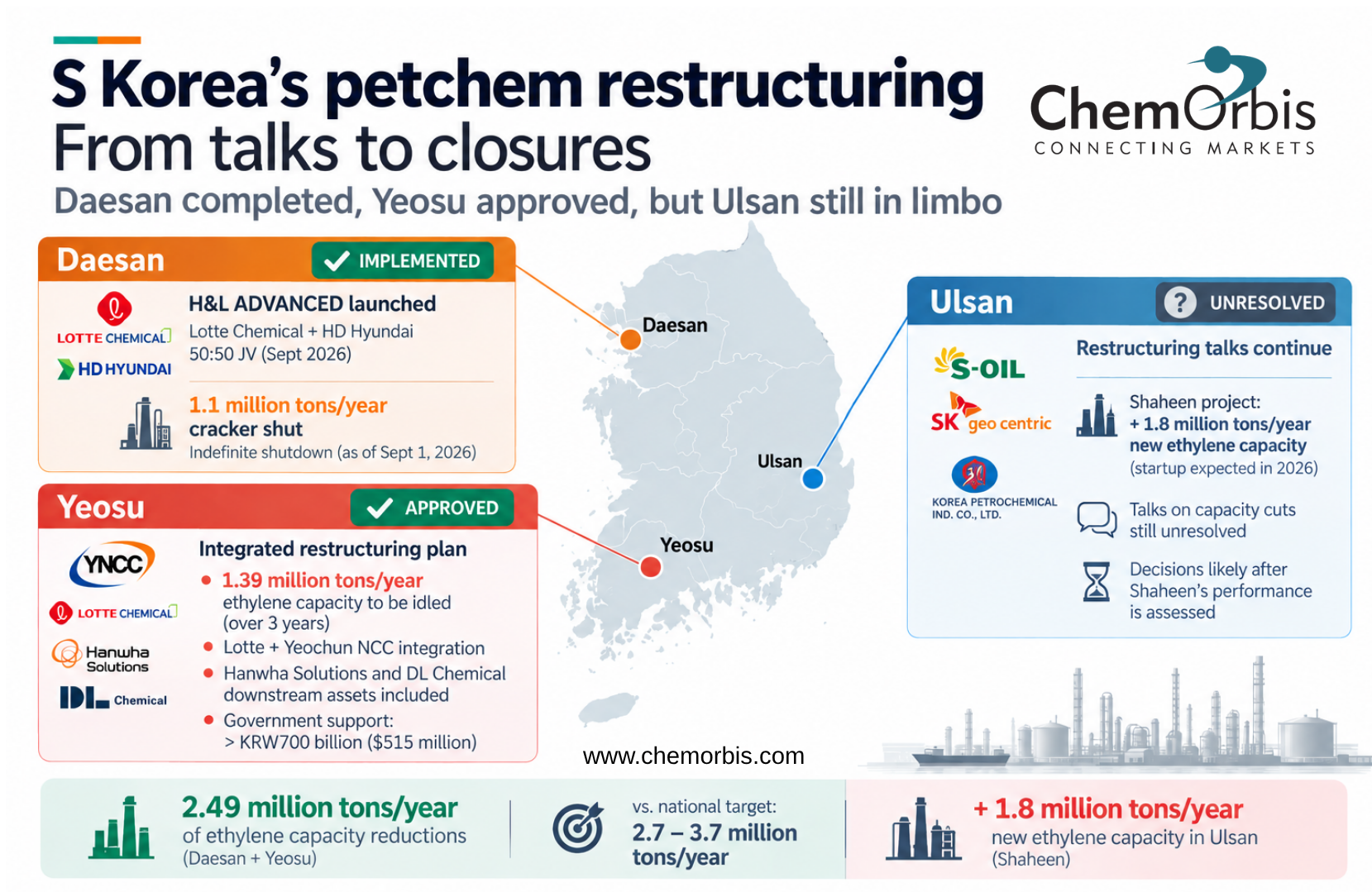
Since early April, when restructuring efforts were still largely centered on negotiations among producers, South Korea has taken several significant steps toward its goal of reducing domestic naphtha cracking capacity by 2.7-3.7 million tons/year. Lotte Chemical’s 1.1 million tons/year Daesan cracker has now been shut indefinitely, while the Yeosu restructuring plan envisages another 1.39 million tons/year of ethylene capacity being idled over the next three years.
Together, the announced reductions in Daesan and Yeosu amount to around 2.49 million tons/year, bringing South Korea considerably closer to the lower end of its nationwide capacity reduction target.
Daesan becomes first restructuring plan to reach implementation
Daesan has seen the clearest progress since April.
Lotte Chemical and HD Hyundai completed the integration of their petrochemical businesses with the launch of H&L Advanced in early September. The new company, equally owned by Lotte Chemical and HD Hyundai Oilbank, combines HD Hyundai Chemical with Lotte’s Daesan petrochemical operations.
The transaction cleared its final major regulatory hurdle in August, when South Korea’s Fair Trade Commission conditionally approved the combination. The regulator imposed five-year safeguards covering domestic LDPE and EVA prices and supply amid concerns that the merger would significantly increase concentration in the two markets.
The restructuring has also resulted in a tangible reduction in upstream capacity. Lotte Chemical’s 1.1 million tons/year Daesan naphtha cracker was taken offline on September 1 and will remain shut indefinitely, representing roughly 30-40% of the government’s overall targeted reduction in domestic cracking capacity.
H&L Advanced plans to improve competitiveness by integrating refining and petrochemical operations while gradually shifting away from commodity products toward specialty and lower-carbon materials.
Yeosu moves from negotiations to approved capacity cuts
The restructuring process in Yeosu has also advanced substantially.
In July, the government approved a restructuring plan for the Yeosu petrochemical complex centered on the integration of Yeochun NCC with Lotte Chemical’s Yeosu naphtha cracking and basic materials businesses. Hanwha Solutions and DL Chemical are also participating through downstream polyethylene and resin assets.
The plan calls for 1.39 million tons/year of ethylene capacity to be idled over the next three years, making Yeosu the second major restructuring project to receive government approval after Daesan.
The government has pledged more than KRW700 billion ($515 million) in financing, tax incentives and regulatory support for the project. Alongside capacity rationalization, the participating companies aim to redirect investment toward higher-value products, including specialty polyethylene and other differentiated materials.
The development marks a significant change from April, when the parties had only recently submitted their final integration proposal and questions remained over which crackers and downstream assets would ultimately be included.
Meanwhile, progress on the other major Yeosu restructuring track has remained slower. LG Chem and GS Caltex have continued discussions over integrating their Yeosu cracker operations, although governance and ownership issues have delayed a final agreement.
Ulsan remains the missing piece
Progress has been considerably slower in Ulsan, where S-Oil, SK geocentric and Korea Petrochemical Ind have struggled to reach agreement over restructuring measures.
By late May, restructuring talks were already facing delays amid differences among stakeholders over issues including asset valuations and future production strategies.
More importantly, S-Oil’s Shaheen project has fundamentally changed the capacity equation in the region. The project will bring 1.8 million tons/year of new ethylene capacity, making it considerably larger than the existing individual crackers operated in Ulsan. The massive investment is based on newer technology and greater refinery-petrochemical integration, potentially giving it a significant cost advantage over older naphtha-based facilities.
By June, industry sources and government officials indicated that South Korea was likely to assess the Shaheen Project before deciding on Ulsan capacity cuts. Its commercial performance is expected to play an important role in determining which facilities, if any, should ultimately be included in the region’s restructuring.
2.49 million tons/year earmarked, but restructuring is far from over
The developments since April show that South Korea’s restructuring drive has entered a more concrete phase. Daesan has moved all the way from integration plans to an operational joint venture and an actual cracker shutdown, while Yeosu has secured government approval for another major round of capacity rationalization.
The two projects together account for around 2.49 million tons/year of planned or completed ethylene capacity reductions, approaching the government’s nationwide target of 2.7-3.7 million tons/year.
Yet the headline number does not tell the whole story. The arrival of Shaheen’s 1.8 million tons/year cracker means South Korea is simultaneously replacing part of its older capacity with a much larger and potentially more competitive production base.
Since early April, when restructuring efforts were still largely centered on negotiations among producers, South Korea has taken several significant steps toward its goal of reducing domestic naphtha cracking capacity by 2.7-3.7 million tons/year. Lotte Chemical’s 1.1 million tons/year Daesan cracker has now been shut indefinitely, while the Yeosu restructuring plan envisages another 1.39 million tons/year of ethylene capacity being idled over the next three years.
Together, the announced reductions in Daesan and Yeosu amount to around 2.49 million tons/year, bringing South Korea considerably closer to the lower end of its nationwide capacity reduction target.
Daesan becomes first restructuring plan to reach implementation
Daesan has seen the clearest progress since April.
Lotte Chemical and HD Hyundai completed the integration of their petrochemical businesses with the launch of H&L Advanced in early September. The new company, equally owned by Lotte Chemical and HD Hyundai Oilbank, combines HD Hyundai Chemical with Lotte’s Daesan petrochemical operations.
The transaction cleared its final major regulatory hurdle in August, when South Korea’s Fair Trade Commission conditionally approved the combination. The regulator imposed five-year safeguards covering domestic LDPE and EVA prices and supply amid concerns that the merger would significantly increase concentration in the two markets.
The restructuring has also resulted in a tangible reduction in upstream capacity. Lotte Chemical’s 1.1 million tons/year Daesan naphtha cracker was taken offline on September 1 and will remain shut indefinitely, representing roughly 30-40% of the government’s overall targeted reduction in domestic cracking capacity.
H&L Advanced plans to improve competitiveness by integrating refining and petrochemical operations while gradually shifting away from commodity products toward specialty and lower-carbon materials.
Yeosu moves from negotiations to approved capacity cuts
The restructuring process in Yeosu has also advanced substantially.
In July, the government approved a restructuring plan for the Yeosu petrochemical complex centered on the integration of Yeochun NCC with Lotte Chemical’s Yeosu naphtha cracking and basic materials businesses. Hanwha Solutions and DL Chemical are also participating through downstream polyethylene and resin assets.
The plan calls for 1.39 million tons/year of ethylene capacity to be idled over the next three years, making Yeosu the second major restructuring project to receive government approval after Daesan.
The government has pledged more than KRW700 billion ($515 million) in financing, tax incentives and regulatory support for the project. Alongside capacity rationalization, the participating companies aim to redirect investment toward higher-value products, including specialty polyethylene and other differentiated materials.
The development marks a significant change from April, when the parties had only recently submitted their final integration proposal and questions remained over which crackers and downstream assets would ultimately be included.
Meanwhile, progress on the other major Yeosu restructuring track has remained slower. LG Chem and GS Caltex have continued discussions over integrating their Yeosu cracker operations, although governance and ownership issues have delayed a final agreement.
Ulsan remains the missing piece
Progress has been considerably slower in Ulsan, where S-Oil, SK geocentric and Korea Petrochemical Ind have struggled to reach agreement over restructuring measures.
By late May, restructuring talks were already facing delays amid differences among stakeholders over issues including asset valuations and future production strategies.
More importantly, S-Oil’s Shaheen project has fundamentally changed the capacity equation in the region. The project will bring 1.8 million tons/year of new ethylene capacity, making it considerably larger than the existing individual crackers operated in Ulsan. The massive investment is based on newer technology and greater refinery-petrochemical integration, potentially giving it a significant cost advantage over older naphtha-based facilities.
By June, industry sources and government officials indicated that South Korea was likely to assess the Shaheen Project before deciding on Ulsan capacity cuts. Its commercial performance is expected to play an important role in determining which facilities, if any, should ultimately be included in the region’s restructuring.
This creates an unusual contrast within South Korea’s restructuring drive: while older capacity is being removed in Daesan and Yeosu, substantial new capacity is simultaneously preparing to enter the market in Ulsan.
2.49 million tons/year earmarked, but restructuring is far from over
The developments since April show that South Korea’s restructuring drive has entered a more concrete phase. Daesan has moved all the way from integration plans to an operational joint venture and an actual cracker shutdown, while Yeosu has secured government approval for another major round of capacity rationalization.
The two projects together account for around 2.49 million tons/year of planned or completed ethylene capacity reductions, approaching the government’s nationwide target of 2.7-3.7 million tons/year.
Yet the headline number does not tell the whole story. The arrival of Shaheen’s 1.8 million tons/year cracker means South Korea is simultaneously replacing part of its older capacity with a much larger and potentially more competitive production base.
The next stage of restructuring may therefore be less about simply cutting capacity and increasingly about which assets survive as South Korea reshapes its petrochemical industry around newer, more integrated and higher-value production.
More free plastics news
Plastic resin (PP, LDPE, LLDPE ,HDPE, PVC, GPS; HIPS, PET, ABS) prices, polymer market trends, and more...- Europe’s petchem plants close, assets change hands: How far has restructuring progressed?
- Suez recovery gains ground, but global shipping remains far from normal
- Saudi pipeline outage compounds supply and logistics risks, fueling PP, PE rally
- European natural gas, Asian LNG hit fresh highs amid Middle East tensions
- Global shipping faces persistent bottlenecks across major trade routes
- War or recovery? H1 earnings reshuffle petchem winners and losers
- Oil roller coaster in July H2 fails to derail most polymer rallies
- Dow’s €1.1 billion claim puts Europe’s ethylene cartel dispute back in focus
- Crude oil surges on renewed war premium; will it reverse the polymer slump?
- EU publishes tariff regulation, swings doors wide open to duty-free US plastics