



Saudi pipeline outage compounds supply and logistics risks, fueling PP, PE rally
by Esra Ersöz - eersoz@chemorbis.com
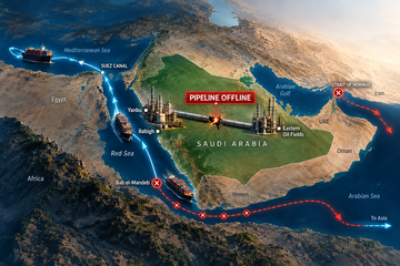
Saudi Arabia’s petrochemical industry is facing mounting operational and logistical challenges. The recent East-West Pipeline shutdown has raised feedstock concerns for west-coast facilities, while disruptions at Bab el-Mandeb are complicating feedstock flows to Asia. Although polymer exports continue, port congestion, inland rerouting and longer delivery schedules are reducing the efficiency and predictability of Saudi supply.
The disruptions come at a sensitive time for global polymer markets. Sharply higher energy and feedstock costs have already pushed PP and PE prices higher across several regions. On top of that, supply constraints and logistics issues from Saudi Arabia, which is a major exporter of PP and PE, have supported the uptrend in Türkiye, India, Southeast Asia, China as well as in Egypt and the rest of Africa, while European markets are even feeling the constraints of Middle Eastern supplies.
Pipeline outage puts west-coast petchem production in Rabigh and Yanbu at risk
The most immediate concern for Saudi Arabia’s petrochemical industry centers on the prolonged shutdown of the East-West Pipeline, which has remained offline since September 10 after multiple drone attacks damaged the key conduit connecting the kingdom’s eastern oil-producing region with its Red Sea coast.
The pipeline has taken on greater strategic importance since disruptions around the Strait of Hormuz complicated flows through Saudi Arabia’s Gulf coast, making the west coast an increasingly important alternative for moving Saudi energy and petrochemical supplies.
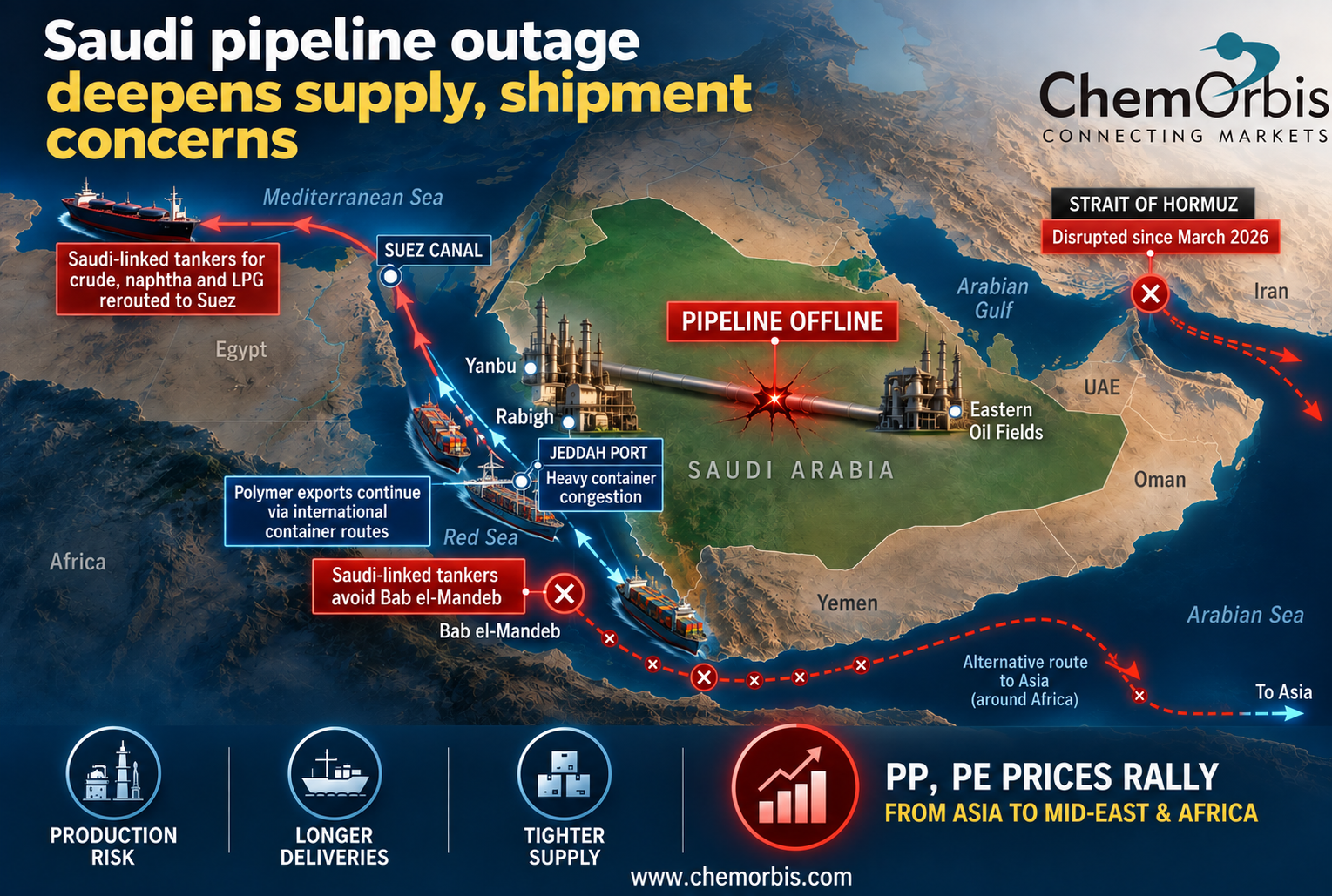
The pressure on west-coast flows has become increasingly visible. Yanbu crude loadings have reportedly been halted, with some Asian buyers receiving notices of delays and some September cargoes bound for Europe being cancelled. Saudi Arabia has meanwhile sought to compensate by increasing loadings from its Gulf coast and using alternative outlets, including Oman.
The uncertainty has also spilled into Saudi equity markets. Luberef shares fell by their 10% daily limit on September 13, while Yansab and Petro Rabigh declined by 5% and 4%, respectively, reflecting investor concerns that a prolonged pipeline outage could eventually translate into lower operating rates.
Logistics bottlenecks for Saudi exports grow
Saudi exporters have increasingly relied on alternative routes as regional chokepoints remain disrupted, although the impact differs significantly between tanker and container shipping.
Red Sea blockade forces Saudi feedstock cargoes to reroute
On the tanker side, crude and feedstock flows from Saudi Arabia’s west coast have faced growing disruption after the Houthis imposed a blockade on Saudi vessels transiting Bab el-Mandeb, raising the risk of attacks on Saudi-linked shipping. As a result, some LPG and naphtha cargoes loaded at Yanbu have avoided the strait and instead headed north through the Suez Canal. For cargoes originally destined for Asian markets, such diversions can substantially lengthen voyages and increase freight and tonnage requirements.
Kpler has tracked several examples of this rerouting in Saudi LPG and naphtha trade, with Yanbu-loaded vessels heading north through Suez rather than south through Bab el-Mandeb. The disruption is particularly relevant to petrochemical markets as it complicates the movement of key feedstocks and can raise regional replacement and logistics costs.
Container shipments for polymers continue despite Red Sea risks
The picture is notably different for polymers transported in containers. Saudi PP and PE exports have not been cut off from international markets. Major international shipping lines continue to call at Jeddah, while Maersk and Hapag-Lloyd have been progressively restoring services through the Red Sea and Suez Canal.
In the latest move, Maersk and Hapag-Lloyd said four Gemini Cooperation services - AE5 between Asia and Northern Europe, AE11 and AE12 between Asia and the Mediterranean, and ME2 between India and Europe - would shift from the Cape of Good Hope route back to the Suez Canal. They will join AE15 and AE19, which are already operating through the Suez and Red Sea corridor. The carriers said the move would shorten transit times, although continued use of the route remains conditional on security conditions.
Jeddah also remains connected to these international liner networks, meaning Saudi polymer cargoes can continue moving to overseas markets despite the difficulties affecting Saudi-linked tanker traffic around Bab el-Mandeb.
Jeddah congestion keeps polymer logistics under strain
However, continued access does not mean logistics have normalized.
High cargo flows have created considerable pressure at Saudi Arabia’s western gateways. Maersk reported elevated volumes at Jeddah and King Abdullah Port in September, with congestion extending container collection and truck turnaround times, while also affecting empty-container returns and equipment availability.
Inland logistics have therefore become increasingly important as shippers adapt to disruptions around the Arabian Peninsula. Maersk currently offers inland connections linking Jeddah with Riyadh and Dammam, as well as regional connections involving Bahrain and Kuwait. These alternatives keep cargo moving, but add another logistical layer to supply chains already facing congestion and unpredictable delivery schedules.
As a result, the issue for Saudi polymer exports is less one of outright closure than reduced logistical efficiency. Longer lead times, port congestion, inland transport requirements and less predictable arrivals can effectively reduce the amount of prompt Middle Eastern material available to buyers, even while physical exports continue.
Tighter Middle Eastern availability adds fuel to global PP, PE rally
These disruptions are unfolding against an already bullish backdrop for global polymer markets, where surging energy and feedstock costs have driven PP and PE prices higher across several regions.
Türkiye has been particularly exposed to logistical disruptions involving Middle Eastern supply. Lengthy delivery schedules for seaborne Middle Eastern PP cargoes have compounded limited availability from other origins, while prompt and nearby material has commanded a premium. PE markets have faced similar constraints, particularly for LDPE and HDPE film, amid tight local and import availability and unpredictable delivery schedules.
Across Asia, rising replacement costs have also pushed polymer markets higher. In India, PP and PE prices have extended their rally into September amid surging upstream costs, elevated freight rates and firmer import parity, including for Middle Eastern cargoes.
In Vietnam, import prices climbed to three-month highs, while some Saudi cargoes for November and December delivery were heard at competitive levels amid the possibility of significant additional surcharges during delivery. Vietnam’s local markets have followed a similar trend, with PP and PE climbing to multi-month highs on firmer import replacement costs and rising energy and regional monomer prices despite persistent buyer resistance.
China’s PP markets and PE markets have also continued their upward run on the heels of elevated energy costs, tighter supply and seasonal improvements in demand.
Needless to say, Egypt and the rest of Africa markets including Nigeria, Kenya and Algeria, Tunisia, Morocco have also seen higher prices this month with support from surging costs as well as supply limitations from the regular Middle Eastern suppliers.
Even Europe, where weak demand has largely kept price increases in check, has felt mounting supply constraints. Surging crude oil and natural gas prices have strengthened producers’ replacement-cost arguments, while tighter availability — partly stemming from reduced Middle Eastern supply — has lent additional support to certain PE grades, particularly LDPE.
Long story short
The combined picture suggests that Saudi Arabia does not need to stop exporting polymers altogether to exert additional pressure on global markets. Slower and less predictable cargo flows, coupled with tighter feedstock availability and the risk of production disruptions on the west coast, can effectively reduce the volume of prompt Middle Eastern material available to buyers.
With PP and PE markets already responding to elevated energy and replacement costs, a prolonged disruption to Saudi production or further deterioration in regional logistics could reinforce supply tightness and provide additional support to the rally across Asia, the Middle East, Africa and Europe.
The disruptions come at a sensitive time for global polymer markets. Sharply higher energy and feedstock costs have already pushed PP and PE prices higher across several regions. On top of that, supply constraints and logistics issues from Saudi Arabia, which is a major exporter of PP and PE, have supported the uptrend in Türkiye, India, Southeast Asia, China as well as in Egypt and the rest of Africa, while European markets are even feeling the constraints of Middle Eastern supplies.
Pipeline outage puts west-coast petchem production in Rabigh and Yanbu at risk
The most immediate concern for Saudi Arabia’s petrochemical industry centers on the prolonged shutdown of the East-West Pipeline, which has remained offline since September 10 after multiple drone attacks damaged the key conduit connecting the kingdom’s eastern oil-producing region with its Red Sea coast.
The pipeline has taken on greater strategic importance since disruptions around the Strait of Hormuz complicated flows through Saudi Arabia’s Gulf coast, making the west coast an increasingly important alternative for moving Saudi energy and petrochemical supplies.
Among the major polymer producers operating on the Red Sea coast are Yansab in Yanbu, which produces PP, HDPE and LLDPE, and Petro Rabigh, an integrated refining and petrochemical complex producing several PE grades as well as PP.
Yousef Husseini, director of chemical equity research at EFG Hermes, warned that west-coast refineries could eventually be forced to shut if the East-West Pipeline is not repaired in time. Petrochemical companies reportedly have only “days of inventory” available, although no producer has so far announced a shutdown or production reduction as a direct result of the pipeline outage.
The pressure on west-coast flows has become increasingly visible. Yanbu crude loadings have reportedly been halted, with some Asian buyers receiving notices of delays and some September cargoes bound for Europe being cancelled. Saudi Arabia has meanwhile sought to compensate by increasing loadings from its Gulf coast and using alternative outlets, including Oman.
The uncertainty has also spilled into Saudi equity markets. Luberef shares fell by their 10% daily limit on September 13, while Yansab and Petro Rabigh declined by 5% and 4%, respectively, reflecting investor concerns that a prolonged pipeline outage could eventually translate into lower operating rates.
Logistics bottlenecks for Saudi exports grow
Saudi exporters have increasingly relied on alternative routes as regional chokepoints remain disrupted, although the impact differs significantly between tanker and container shipping.
Red Sea blockade forces Saudi feedstock cargoes to reroute
On the tanker side, crude and feedstock flows from Saudi Arabia’s west coast have faced growing disruption after the Houthis imposed a blockade on Saudi vessels transiting Bab el-Mandeb, raising the risk of attacks on Saudi-linked shipping. As a result, some LPG and naphtha cargoes loaded at Yanbu have avoided the strait and instead headed north through the Suez Canal. For cargoes originally destined for Asian markets, such diversions can substantially lengthen voyages and increase freight and tonnage requirements.
Kpler has tracked several examples of this rerouting in Saudi LPG and naphtha trade, with Yanbu-loaded vessels heading north through Suez rather than south through Bab el-Mandeb. The disruption is particularly relevant to petrochemical markets as it complicates the movement of key feedstocks and can raise regional replacement and logistics costs.
Container shipments for polymers continue despite Red Sea risks
The picture is notably different for polymers transported in containers. Saudi PP and PE exports have not been cut off from international markets. Major international shipping lines continue to call at Jeddah, while Maersk and Hapag-Lloyd have been progressively restoring services through the Red Sea and Suez Canal.
In the latest move, Maersk and Hapag-Lloyd said four Gemini Cooperation services - AE5 between Asia and Northern Europe, AE11 and AE12 between Asia and the Mediterranean, and ME2 between India and Europe - would shift from the Cape of Good Hope route back to the Suez Canal. They will join AE15 and AE19, which are already operating through the Suez and Red Sea corridor. The carriers said the move would shorten transit times, although continued use of the route remains conditional on security conditions.
Jeddah also remains connected to these international liner networks, meaning Saudi polymer cargoes can continue moving to overseas markets despite the difficulties affecting Saudi-linked tanker traffic around Bab el-Mandeb.
Jeddah congestion keeps polymer logistics under strain
However, continued access does not mean logistics have normalized.
High cargo flows have created considerable pressure at Saudi Arabia’s western gateways. Maersk reported elevated volumes at Jeddah and King Abdullah Port in September, with congestion extending container collection and truck turnaround times, while also affecting empty-container returns and equipment availability.
Inland logistics have therefore become increasingly important as shippers adapt to disruptions around the Arabian Peninsula. Maersk currently offers inland connections linking Jeddah with Riyadh and Dammam, as well as regional connections involving Bahrain and Kuwait. These alternatives keep cargo moving, but add another logistical layer to supply chains already facing congestion and unpredictable delivery schedules.
As a result, the issue for Saudi polymer exports is less one of outright closure than reduced logistical efficiency. Longer lead times, port congestion, inland transport requirements and less predictable arrivals can effectively reduce the amount of prompt Middle Eastern material available to buyers, even while physical exports continue.
Tighter Middle Eastern availability adds fuel to global PP, PE rally
These disruptions are unfolding against an already bullish backdrop for global polymer markets, where surging energy and feedstock costs have driven PP and PE prices higher across several regions.
Türkiye has been particularly exposed to logistical disruptions involving Middle Eastern supply. Lengthy delivery schedules for seaborne Middle Eastern PP cargoes have compounded limited availability from other origins, while prompt and nearby material has commanded a premium. PE markets have faced similar constraints, particularly for LDPE and HDPE film, amid tight local and import availability and unpredictable delivery schedules.
Across Asia, rising replacement costs have also pushed polymer markets higher. In India, PP and PE prices have extended their rally into September amid surging upstream costs, elevated freight rates and firmer import parity, including for Middle Eastern cargoes.
In Vietnam, import prices climbed to three-month highs, while some Saudi cargoes for November and December delivery were heard at competitive levels amid the possibility of significant additional surcharges during delivery. Vietnam’s local markets have followed a similar trend, with PP and PE climbing to multi-month highs on firmer import replacement costs and rising energy and regional monomer prices despite persistent buyer resistance.
China’s PP markets and PE markets have also continued their upward run on the heels of elevated energy costs, tighter supply and seasonal improvements in demand.
Needless to say, Egypt and the rest of Africa markets including Nigeria, Kenya and Algeria, Tunisia, Morocco have also seen higher prices this month with support from surging costs as well as supply limitations from the regular Middle Eastern suppliers.
Even Europe, where weak demand has largely kept price increases in check, has felt mounting supply constraints. Surging crude oil and natural gas prices have strengthened producers’ replacement-cost arguments, while tighter availability — partly stemming from reduced Middle Eastern supply — has lent additional support to certain PE grades, particularly LDPE.
Long story short
The combined picture suggests that Saudi Arabia does not need to stop exporting polymers altogether to exert additional pressure on global markets. Slower and less predictable cargo flows, coupled with tighter feedstock availability and the risk of production disruptions on the west coast, can effectively reduce the volume of prompt Middle Eastern material available to buyers.
With PP and PE markets already responding to elevated energy and replacement costs, a prolonged disruption to Saudi production or further deterioration in regional logistics could reinforce supply tightness and provide additional support to the rally across Asia, the Middle East, Africa and Europe.
More free plastics news
Plastic resin (PP, LDPE, LLDPE ,HDPE, PVC, GPS; HIPS, PET, ABS) prices, polymer market trends, and more...- Europe’s petchem plants close, assets change hands: How far has restructuring progressed?
- Suez recovery gains ground, but global shipping remains far from normal
- S Korea’s petchem restructuring moves from talks to closures
- European natural gas, Asian LNG hit fresh highs amid Middle East tensions
- Global shipping faces persistent bottlenecks across major trade routes
- War or recovery? H1 earnings reshuffle petchem winners and losers
- Oil roller coaster in July H2 fails to derail most polymer rallies
- Dow’s €1.1 billion claim puts Europe’s ethylene cartel dispute back in focus
- Crude oil surges on renewed war premium; will it reverse the polymer slump?
- EU publishes tariff regulation, swings doors wide open to duty-free US plastics