
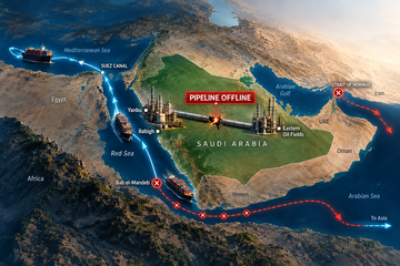



Suez recovery gains ground, but global shipping remains far from normal

Elsewhere, however, relief has proved elusive. Traffic through the Strait of Hormuz remains severely constrained, congestion continues to complicate Middle Eastern and Asian shipping, while exceptionally low Rhine water levels and growing pressure at the Panama Canal are creating bottlenecks far removed from geopolitical hotspots. Meanwhile, route-specific surcharges and reduced carrier options are adding another layer of uncertainty for Türkiye.
The result is a global shipping network that is beginning to normalize along one of its most important arteries without seeing the same improvement spread across the broader logistics system.
| Pressure point | Current status | Key issue / change since August |
| Strait of Hormuz | 🔴 Critical | Little improvement; traffic remains severely constrained |
| Jeddah | 🟠 Congested | Congestion persists despite expanding Red Sea/Suez traffic |
| China ports | 🟠 Disrupted | Congestion has intensified again ahead of Golden Week |
| Rhine | 🔴 Severe | August improvement proved temporary; water levels have fallen back to extreme lows |
| Panama Canal | 🟠 Under pressure | Pressure persists amid water concerns and stronger competition for transit capacity |
| Türkiye–Russia | 🟠 Constrained | New pressure point: carrier withdrawals have narrowed container options |
| Red Sea / Suez | 🟢 Improving | Recovery has gained pace since August as more services return |
Major carriers, including Maersk, Hapag-Lloyd and MSC, are gradually increasing their Suez transits, citing shorter and more efficient transit times. The returning services span major Asia-North Europe, Asia-Mediterranean and India-Europe routes, marking a further step in the gradual restoration of the Red Sea-Suez corridor.
The expanding return is now coinciding with a marked decline in freight costs. According to Freightos, China/East Asia-North Europe rates have fallen from around $5,500 to $3,700 since early August, a drop of roughly 33%. China/East Asia-Mediterranean rates have fallen even more sharply, from around $6,500 to $3,880, representing a decline of about 40%.
Rates have also moved lower in the opposite direction, although from much lower bases. North Europe-China/East Asia rates declined from $540 to $465, while Mediterranean-China/East Asia rates dropped from $666 to $170.
Hormuz and Jeddah prevent a broader Middle East normalizationThe improvement through Suez does not extend across the Middle East. As the Saudi pipeline outage compounded existing supply and logistics risks, the region’s logistics map became increasingly divided between recovering container routes through the Red Sea and severe constraints elsewhere.
Traffic through the Strait of Hormuz remains particularly depressed. Preliminary Kpler data showed only four commodity vessels crossing the strait on September 17, compared with a 10-day average of around 16. While daily figures can fluctuate, they point to continued severe disruption through the strategic waterway.
Meanwhile, the return of container services through the Red Sea is not translating into frictionless operations at regional ports. Jeddah continues to face heavy congestion as shifting cargo patterns and renewed Red Sea traffic place pressure on the Saudi gateway.
China congestion threatens to dilute some Suez gainsProblems are also mounting at the Asian end of the trade lane. Congestion at China’s largest container ports has intensified ahead of Golden Week, after weather-related closures disrupted vessel schedules at Shanghai and Ningbo-Zhoushan in early September.
Operational data reported on September 8 showed seven-day average vessel waiting times of 4.72 days at Shanghai and 3.58 days at Ningbo, with waits exceeding seven to nine days at some terminals. Vessel bunching and cargo backlogs are now colliding with planned Golden Week capacity reductions.
Carriers have announced blank sailings around the holiday period, including on Asia-Europe services. This leaves relatively little time for ports and shipping networks to clear accumulated delays before the holiday slowdown.
The development illustrates an important limit to the Suez recovery. Shorter routings between Asia and Europe do not automatically restore schedule reliability if vessels lose time before leaving major Asian gateways.
Rhine and Panama keep non-geopolitical risks elevatedNot all of the pressure on global logistics stems from conflict. Europe is again confronting extremely low water levels on the Rhine after the tentative improvement expected in August failed to hold.
At Kaub, the critical navigation point near Koblenz, the navigable water gauge stood at around 15 cm on Monday, down from 26 cm on Friday, according to Germany’s inland navigation agency WSV. The gauge had already fallen below 10 cm in mid-August, below the previous lowest recorded level of 25 cm in 2018. With no major improvement expected in the coming week, low water continues to force barges to reduce loads, complicating the movement of chemicals, feedstocks and industrial products through Germany’s key inland transport artery and eventually raising prices.
Pressure is also building at the Panama Canal as water constraints and competition for transit capacity intensify. Since the beginning of July, bulker transits have fallen 22% year on year, according to BIMCO. Bulk carriers are facing stronger competition for transit slots, particularly from tankers as the US boosts energy exports to Asia, while El Niño is expected to put further downward pressure on water levels and potentially tighten transit restrictions.
The two waterways underline a broader vulnerability: even as one of the world’s major maritime corridors begins to recover, climate and infrastructure constraints can simultaneously reduce transport flexibility elsewhere.
Türkiye faces higher costs and fewer options on some routesTürkiye provides another example of how improving headline freight conditions can coexist with route-specific pressure.
Even as Asia-Europe freight rates decline, MSC has introduced new surcharges on Asia shipments to Türkiye. Effective September 15, the carrier imposed a $55/TEU Piracy Risk Surcharge and a $36/TEU Suez Canal Surcharge, adding a combined $91/TEU to affected cargoes bound for Türkiye and other East Mediterranean and Black Sea ports.
At the same time, container shipping options between Türkiye and Russia have narrowed as carriers pull back. Akkon and Arkas have suspended Russian operations following earlier withdrawals or service suspensions by MSC and Fesco amid heightened Black Sea security risks.
Alternative operators continue to connect Turkish and Russian ports, meaning container trade has not been cut off. Nevertheless, the shrinking pool of carriers highlights how lower benchmark freight rates can coexist with higher route-specific costs and reduced service choice.
Search for alternatives grows, but scale remains limitedPersistent disruption is also encouraging logistics companies and governments to explore alternatives to established maritime routes. However, both overland and Arctic options remain small in scale compared with conventional seaborne trade.
| Alternative route | Transit time | Current scale/status |
| Europe–Gulf trucking via Türkiye | ~2 weeks Europe–Dubai | Limited – 100+ Aramex journeys; DP World up to 50 trucks/week |
| Asia–Europe Arctic route | 21 days Busan–Felixstowe | Experimental – first Korean trial; 8 Chinese sailings planned |
The shorter distance and transit time offer obvious attractions, but these remain trials and limited commercial sailings rather than evidence of a large-scale shift in Asia-Europe container flows. Issues ranging from seasonal navigation and insurance to costs and schedule reliability still need to be tested before the route could assume a meaningful role in mainstream container shipping.
Normalization is moving at different speedsThe past month therefore marks a meaningful change in the global shipping picture, but not a return to normal. In August, the reopening of the Red Sea-Suez corridor remained tentative. By late September, the recovery has gained enough momentum to produce a visible impact on Asia-Europe freight rates, providing one of the clearest signs of logistics relief seen this year.
Yet that improvement remains highly localized. Hormuz is still severely disrupted, congestion is complicating flows through Jeddah and major Chinese ports, Rhine navigation is again constrained by exceptionally low water levels, and pressure at the Panama Canal is intensifying. Meanwhile, security risks are creating additional costs and limiting carrier choice on selected Türkiye routes.
The search for overland and Arctic alternatives shows how logistics providers are responding to this uncertainty, but neither currently has the scale to fundamentally redraw global cargo flows.
For polymer markets, the distinction is important. Falling headline freight rates can reduce the cost of moving material on some trade lanes without restoring the predictability of when, or through which route, that material will arrive. The latest developments therefore point not to a synchronized recovery in global shipping, but to a logistics network normalizing at markedly different speeds.
More free plastics news
Plastic resin (PP, LDPE, LLDPE ,HDPE, PVC, GPS; HIPS, PET, ABS) prices, polymer market trends, and more...- Europe’s petchem plants close, assets change hands: How far has restructuring progressed?
- Saudi pipeline outage compounds supply and logistics risks, fueling PP, PE rally
- S Korea’s petchem restructuring moves from talks to closures
- European natural gas, Asian LNG hit fresh highs amid Middle East tensions
- Global shipping faces persistent bottlenecks across major trade routes
- War or recovery? H1 earnings reshuffle petchem winners and losers
- Oil roller coaster in July H2 fails to derail most polymer rallies
- Dow’s €1.1 billion claim puts Europe’s ethylene cartel dispute back in focus
- Crude oil surges on renewed war premium; will it reverse the polymer slump?
- EU publishes tariff regulation, swings doors wide open to duty-free US plastics