







Aggressive imports, long supplies weigh on Europe’s ABS markets
by Manolya Tufan - mtufan@chemorbis.com

Regional ABS markets brace for another round of decreases in November as fresh offers are still pending. Prices have been mostly declining since May, with underlying weakness in demand and supply length being the key drivers. Imports also continued to be offered at aggressive levels, adding to the scene.
November offers awaited lower
As market fundamentals remain weak, ABS prices will retreat further in November. Feedstock settlements for November were completed, with marginal variations in the monthly styrene and ACN contracts. November ACN contracts were down by €5.50/ton ($5.40/ton), while styrene contracts were agreed with €4/ton ($4/ton) increases. Meanwhile, November butadiene settled with €150/ton ($147/ton) drops from October.
Energy prices indicated sharp drops from the highs of August, an indicator that producer margins have seen some relief. That is to say, ABS prices lack support from the cost side as well.
Plus, spot prices are rather inflated, which is making the region a favorable destination for exports. The wide gap between spot ranges and import prices remain intact as aggressive offers for the latter continue to be heard.
Imports stand nearly €500 below spot levels
Even though import volumes are insufficient to meet demand, prices are rather aggressive to create pressure on regional suppliers.
Spot ABS ranges were last assessed at around €2500-2640/ton ($2444-2582/ton) FD, 60 days basis. Meanwhile, South Korean ABS offers were reported at around €2000-2100/ton ($1955-2053/ton) DDP, 60 days, with delivery in December. Although not widely confirmed, some players reported offers even below the €2000/ton level.
With that being said, Asian ABS markets have also been following a downward trajectory amid economic downturn. The depreciation of local currencies and China’s commitment to its zero-Covid policy kept demand subdued, while slumping container freight rates encouraged Asian suppliers to divert their cargoes to Europe.
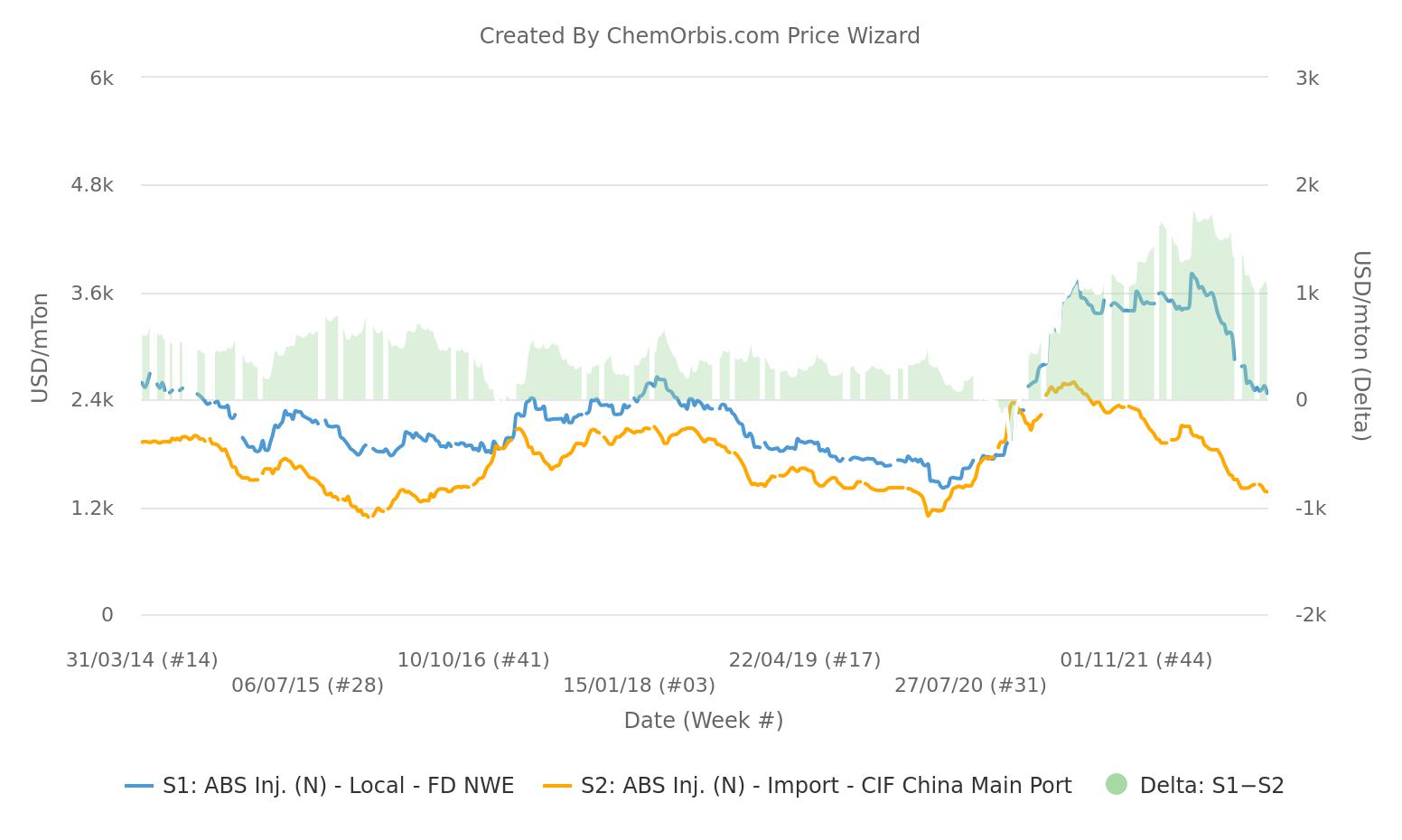
According to the weekly average data on ChemOrbis Price Index, the gap between spot prices on FD Northwest Europe basis and import prices on CIF China basis narrowed to $1100/ton from a record high of $1785/ton in April. Europe’s premium over Asian markets is still well above the pre-pandemic times.
ABS demand weaker than PS
Collapsing downstream demand including automotive and appliances sectors took a hit from spiralling cost of living, affecting ABS more than PS. Consumers cut back on non-essential spending such as electronics and home goods especially in current times of economic downturn. This lowered resin requirements, which could not be counterbalanced by run rate cuts.
Despite regional production cutbacks, availability is still deemed as long. Total’s force majeure declaration and other production hiccups have reportedly reduced styrene output by 30%. Still, its impact on ABS production has been negligible so far.
November offers awaited lower
As market fundamentals remain weak, ABS prices will retreat further in November. Feedstock settlements for November were completed, with marginal variations in the monthly styrene and ACN contracts. November ACN contracts were down by €5.50/ton ($5.40/ton), while styrene contracts were agreed with €4/ton ($4/ton) increases. Meanwhile, November butadiene settled with €150/ton ($147/ton) drops from October.
Energy prices indicated sharp drops from the highs of August, an indicator that producer margins have seen some relief. That is to say, ABS prices lack support from the cost side as well.
Plus, spot prices are rather inflated, which is making the region a favorable destination for exports. The wide gap between spot ranges and import prices remain intact as aggressive offers for the latter continue to be heard.
Imports stand nearly €500 below spot levels
Even though import volumes are insufficient to meet demand, prices are rather aggressive to create pressure on regional suppliers.
Spot ABS ranges were last assessed at around €2500-2640/ton ($2444-2582/ton) FD, 60 days basis. Meanwhile, South Korean ABS offers were reported at around €2000-2100/ton ($1955-2053/ton) DDP, 60 days, with delivery in December. Although not widely confirmed, some players reported offers even below the €2000/ton level.
With that being said, Asian ABS markets have also been following a downward trajectory amid economic downturn. The depreciation of local currencies and China’s commitment to its zero-Covid policy kept demand subdued, while slumping container freight rates encouraged Asian suppliers to divert their cargoes to Europe.
According to the weekly average data on ChemOrbis Price Index, the gap between spot prices on FD Northwest Europe basis and import prices on CIF China basis narrowed to $1100/ton from a record high of $1785/ton in April. Europe’s premium over Asian markets is still well above the pre-pandemic times.
ABS demand weaker than PS
Collapsing downstream demand including automotive and appliances sectors took a hit from spiralling cost of living, affecting ABS more than PS. Consumers cut back on non-essential spending such as electronics and home goods especially in current times of economic downturn. This lowered resin requirements, which could not be counterbalanced by run rate cuts.
Despite regional production cutbacks, availability is still deemed as long. Total’s force majeure declaration and other production hiccups have reportedly reduced styrene output by 30%. Still, its impact on ABS production has been negligible so far.
More free plastics news
Plastic resin (PP, LDPE, LLDPE ,HDPE, PVC, GPS; HIPS, PET, ABS) prices, polymer market trends, and more...- Suez recovery gains ground, but global shipping remains far from normal
- Saudi pipeline outage compounds supply and logistics risks, fueling PP, PE rally
- S Korea’s petchem restructuring moves from talks to closures
- European natural gas, Asian LNG hit fresh highs amid Middle East tensions
- Global shipping faces persistent bottlenecks across major trade routes
- War or recovery? H1 earnings reshuffle petchem winners and losers
- Oil roller coaster in July H2 fails to derail most polymer rallies
- Dow’s €1.1 billion claim puts Europe’s ethylene cartel dispute back in focus
- Crude oil surges on renewed war premium; will it reverse the polymer slump?
- EU publishes tariff regulation, swings doors wide open to duty-free US plastics
