


Europe PP, PE producers gripped by cost burden and demand slump
by Manolya Tufan - mtufan@chemorbis.com
As players leave behind a month of sharp drops, they are discussing how things will evolve in October amid spiking energy costs, recession fears and lower monomer contracts. The majority of players have started to put forward that PP and PE markets have bottomed out in September.
Prices notch a peak-to-trough decline of about 30-40%
Regional polyolefin markets have been steadily falling since they hit their all-time high in May, bringing cumulative drops to around 30-40% by late September.
Accordingly, spot PPH and PPBC inj. prices lost around 40% since May to be reported at an average of €1250-1330/ton for PPH and €1350-1400/ton for PPBC inj. in Italy and West Europe. PE film grades receded by around 30-35% during this period to be reported at €1450-1480/ton for LD, €1350/ton for LLDPE C4 film and €1370-1400/ton for HDPE film on a weekly average.
Although weak fundamentals still put pressure on prices, players now think that higher production costs will prevent suppliers from issuing further drops and even prompt them to cut run rates further. That is to say, they believe that PP and PE markets have hit the bottom at around 20-month low despite €45/ton lower ethylene and €50/ton lower propylene settlement.
Prices clearly stand at elevated levels based on the historical data. Still, this is likely to remain intact so long as energy costs spiral upwards and run rate cuts prevail.
Borealis follows LyondellBasell in announcing energy surcharges
According to market sources, LyondellBasell decided to apply an energy surcharge of €160/ton ($156/ton) in Europe on supplies of polyethylene (PE) and polypropylene (PP) as of September 1, due to increasing natural gas, electricity and freight costs. The company also remarked that the energy surcharge will be subject to variations based on the price movements on EPEX (German European Power Exchange).
Following suit, Borealis have informed its customers in a letter that they will apply an energy surcharge of €180/ton ($176/ton) starting from October 1 due to the energy cost increases. The surcharge will be valid until further notice.
Despite €45-50/ton lower monomer settlements, PP and PE producers will not be reflecting them on their polymer pricing. It remains to be seen whether or not these energy surcharges will see any acceptance among manufacturers due to the poor performance of the derivative markets.
Take a quick look at supply-demand dynamics
The demand outlook remains unpromising as we move towards the fourth quarter. Manufacturers report low order entries across many sectors, attributing this to the consumption hit by rampant inflation. End product pricing remained high due to rising utility costs despite sharp drops in the resin market, which in turn harmed consumption. The situation is not expected to change dramatically soon.
On the supply front, regional producers have started to trim their operating rates by around this summer to realign demand with supply. Higher energy costs will probably prompt more suppliers to run at lower rates until the year-end.
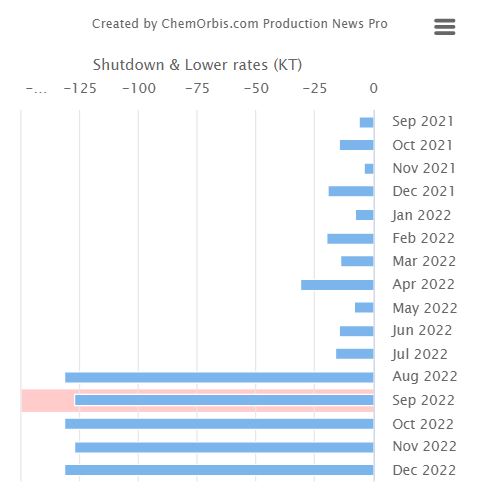
According to ChemOrbis Production News Pro, roughly 400,000 tons of PP capacity is estimated to be offline in the next three months. Similarly, there will be a production loss of around 270,000 tons for LDPE, 235,000 tons for HDPE and 115,000 tons for LLDPE from October to December.
To track the impact of the new additions and the supply balance between new capacities and offline capacities, visit ChemOrbis Production News Pro.
Prices notch a peak-to-trough decline of about 30-40%
Regional polyolefin markets have been steadily falling since they hit their all-time high in May, bringing cumulative drops to around 30-40% by late September.
Accordingly, spot PPH and PPBC inj. prices lost around 40% since May to be reported at an average of €1250-1330/ton for PPH and €1350-1400/ton for PPBC inj. in Italy and West Europe. PE film grades receded by around 30-35% during this period to be reported at €1450-1480/ton for LD, €1350/ton for LLDPE C4 film and €1370-1400/ton for HDPE film on a weekly average.
Although weak fundamentals still put pressure on prices, players now think that higher production costs will prevent suppliers from issuing further drops and even prompt them to cut run rates further. That is to say, they believe that PP and PE markets have hit the bottom at around 20-month low despite €45/ton lower ethylene and €50/ton lower propylene settlement.
Prices clearly stand at elevated levels based on the historical data. Still, this is likely to remain intact so long as energy costs spiral upwards and run rate cuts prevail.
Borealis follows LyondellBasell in announcing energy surcharges
According to market sources, LyondellBasell decided to apply an energy surcharge of €160/ton ($156/ton) in Europe on supplies of polyethylene (PE) and polypropylene (PP) as of September 1, due to increasing natural gas, electricity and freight costs. The company also remarked that the energy surcharge will be subject to variations based on the price movements on EPEX (German European Power Exchange).
Following suit, Borealis have informed its customers in a letter that they will apply an energy surcharge of €180/ton ($176/ton) starting from October 1 due to the energy cost increases. The surcharge will be valid until further notice.
Despite €45-50/ton lower monomer settlements, PP and PE producers will not be reflecting them on their polymer pricing. It remains to be seen whether or not these energy surcharges will see any acceptance among manufacturers due to the poor performance of the derivative markets.
Take a quick look at supply-demand dynamics
The demand outlook remains unpromising as we move towards the fourth quarter. Manufacturers report low order entries across many sectors, attributing this to the consumption hit by rampant inflation. End product pricing remained high due to rising utility costs despite sharp drops in the resin market, which in turn harmed consumption. The situation is not expected to change dramatically soon.
On the supply front, regional producers have started to trim their operating rates by around this summer to realign demand with supply. Higher energy costs will probably prompt more suppliers to run at lower rates until the year-end.
According to ChemOrbis Production News Pro, roughly 400,000 tons of PP capacity is estimated to be offline in the next three months. Similarly, there will be a production loss of around 270,000 tons for LDPE, 235,000 tons for HDPE and 115,000 tons for LLDPE from October to December.
To track the impact of the new additions and the supply balance between new capacities and offline capacities, visit ChemOrbis Production News Pro.
More free plastics news
Plastic resin (PP, LDPE, LLDPE ,HDPE, PVC, GPS; HIPS, PET, ABS) prices, polymer market trends, and more...- After Germany and the Netherlands, Vynova files for bankruptcy in Belgium: Where do its remaining European operations stand?
- Oil price plunge rattles polymer markets: Will the rally lose steam?
- Naphtha rally intensifies in Europe, Asia; Europe hits highest since March 2022
- Europe’s petchem plants close, assets change hands: How far has restructuring progressed?
- Suez recovery gains ground, but global shipping remains far from normal
- Saudi pipeline outage compounds supply and logistics risks, fueling PP, PE rally
- S Korea’s petchem restructuring moves from talks to closures
- European natural gas, Asian LNG hit fresh highs amid Middle East tensions
- Global shipping faces persistent bottlenecks across major trade routes
- War or recovery? H1 earnings reshuffle petchem winners and losers
