

Three weeks into the war, polymer markets extend sharp gains; how will week four unfold amid crude plunge?
Three weeks into the Middle East war, global polymer markets have continued to post sharp gains, extending the rally triggered by the initial disruption to regional supply flows. What began as a supply-driven shock has now evolved into a broader cost-push inflation cycle across the petrochemical chain, with both feedstocks and polymers surging in tandem.
However, as crude oil prices show signs of a sharp correction after flirting with multi-year highs, a key question emerges for market players: will polymer markets sustain their upward momentum into week four, or is the rally nearing an inflection point?
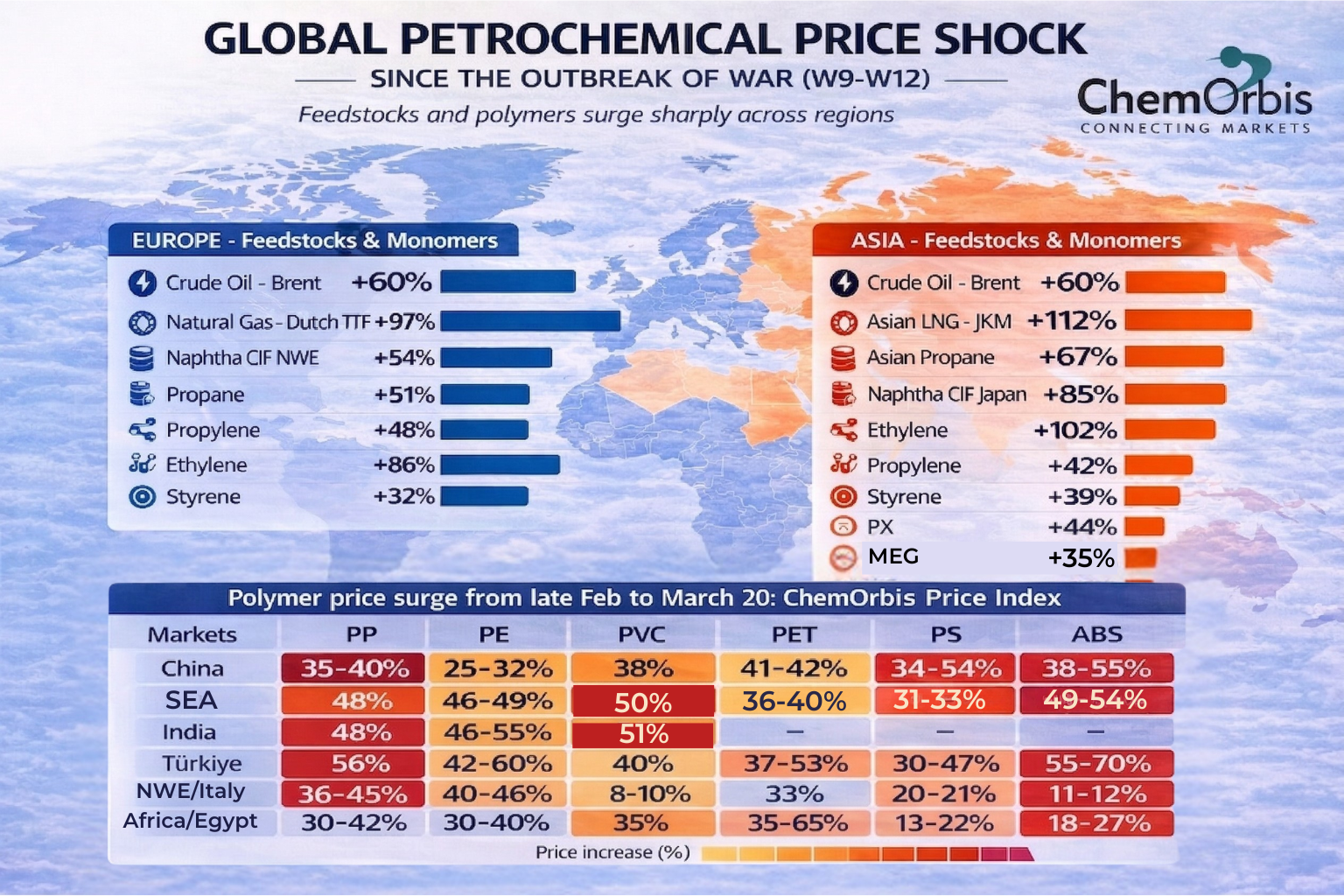
According to ChemOrbis Price Index data, polymer prices have risen steeply across all major markets since late February, with cumulative increases reaching extraordinary levels in several regions.
Asia leads gains, but Europe catches up
Asia remained at the forefront of the rally during the third week, with Vietnam and India recording some of the sharpest increases.
The strength in Asia reflects the region’s heavy reliance on Middle Eastern supply for PP and PE.Even though PVC dependence is limited, the disruption of feedstock supplies including naphtha, LNG and LPG have caused production cutbacks across PVC plants in Asia, and therefore, price jump ensued. PET is also quite sensitive to upstream gains.
Meanwhile, Europe showed a clear catch-up trend in the third week, particularly in polyolefins:
Türkiye and Egypt see extreme volatility
Markets closer to the Middle East disruption have experienced the most pronounced volatility.
In both markets, participants reported rapid price changes, with offers shifting daily or even intra-day as supply uncertainty persists.
Early signs of divergence emerge
Despite the overall uptrend, early signs of divergence have started to appear:
What to expect in week four?
Escalating war risks and possible further attacks on regional energy infrastructurepushed Brent and WTI prices respectively to above $112/bbl and $98/bbl last Friday, the highest since July 2022, while the third week of the war even saw intra-day trading nearing $120/bbl. However, Trump’s announcement that came on Monday about Washington postponing planned strikes on Iranian power plants and energy infrastructure for five days dragged crude oil prices sharply lower, which could mark a turning point for the market.
Brent briefly plunged below $100/bbl during intraday trading, touching as low as $96/bbl before recovering part of the losses.
Scenario 1: Temporary correction
If crude weakness persists, polymer markets may see short-term resistance or pauses. Buyers could delay purchases, expecting lower levels. Sellers may face difficulty sustaining peak prices
Scenario 2: Disconnect between crude and polymers
However, a deeper correction is not guaranteed. This is because supply from the Middle East remains constrained. Logistics disruptions are still unresolved. Feedstock costs (gas, LNG, naphtha) remain elevated. This creates a situation where polymers may decouple from crude in the short term.
Scenario 3: Sharp reversal risk
At the same time, the market remains highly fragile. If geopolitical tensions ease suddenly and Middle Eastern supply returns - although this is not widely expected, the same markets that surged by 40–60% could face equally sharp downward corrections.
However, as crude oil prices show signs of a sharp correction after flirting with multi-year highs, a key question emerges for market players: will polymer markets sustain their upward momentum into week four, or is the rally nearing an inflection point?
According to ChemOrbis Price Index data, polymer prices have risen steeply across all major markets since late February, with cumulative increases reaching extraordinary levels in several regions.
Asia leads gains, but Europe catches up
Asia remained at the forefront of the rally during the third week, with Vietnam and India recording some of the sharpest increases.
- Southeast Asia saw PP rise by 48%, while PE surged 46–49%, with PVC also climbing to 50%.
- India posted gains of 48% for PP and up to 55% for PE, alongside a 51% increase in PVC.
- China, while showing signs of stabilization in some segments, still recorded strong cumulative gains, particularly in PVC (38%) and PET (41–42%).
The strength in Asia reflects the region’s heavy reliance on Middle Eastern supply for PP and PE.Even though PVC dependence is limited, the disruption of feedstock supplies including naphtha, LNG and LPG have caused production cutbacks across PVC plants in Asia, and therefore, price jump ensued. PET is also quite sensitive to upstream gains.
Meanwhile, Europe showed a clear catch-up trend in the third week, particularly in polyolefins:
- PP climbed 36–45%, while PE rose 40–46%, indicating accelerating momentum.
- Downstream polymers such as PS (20–21%) and ABS (11–12%) also strengthened, reflecting delayed cost pass-through.
Türkiye and Egypt see extreme volatility
Markets closer to the Middle East disruption have experienced the most pronounced volatility.
- Türkiye recorded one of the steepest rallies globally, with PP up 56% and PE reaching 42–60%, while ABS surged as high as 70%.
- Egypt also saw strong gains, with PP rising 45% and PE 34–37%, alongside highly volatile PET prices reaching up to 65%.
In both markets, participants reported rapid price changes, with offers shifting daily or even intra-day as supply uncertainty persists.
Early signs of divergence emerge
Despite the overall uptrend, early signs of divergence have started to appear:
- Styrenics (PS, ABS) show signs of stabilization or partial correction in some markets, particularly in China.
- Polyolefins (PP, PE) remain the strongest segment, still driven by tight availability.
- PVC has globally soaredgiven the supply limitations stemming from feedstock shortages from the Middle East whereas Europe’s gains stayed a lot smaller.
- PET is increasingly reflecting cost-driven dynamics rather than supply shortages.
What to expect in week four?
Escalating war risks and possible further attacks on regional energy infrastructurepushed Brent and WTI prices respectively to above $112/bbl and $98/bbl last Friday, the highest since July 2022, while the third week of the war even saw intra-day trading nearing $120/bbl. However, Trump’s announcement that came on Monday about Washington postponing planned strikes on Iranian power plants and energy infrastructure for five days dragged crude oil prices sharply lower, which could mark a turning point for the market.
Brent briefly plunged below $100/bbl during intraday trading, touching as low as $96/bbl before recovering part of the losses.
Scenario 1: Temporary correction
If crude weakness persists, polymer markets may see short-term resistance or pauses. Buyers could delay purchases, expecting lower levels. Sellers may face difficulty sustaining peak prices
Scenario 2: Disconnect between crude and polymers
However, a deeper correction is not guaranteed. This is because supply from the Middle East remains constrained. Logistics disruptions are still unresolved. Feedstock costs (gas, LNG, naphtha) remain elevated. This creates a situation where polymers may decouple from crude in the short term.
Scenario 3: Sharp reversal risk
At the same time, the market remains highly fragile. If geopolitical tensions ease suddenly and Middle Eastern supply returns - although this is not widely expected, the same markets that surged by 40–60% could face equally sharp downward corrections.