

Oil price plunge rattles polymer markets: Will the rally lose steam?

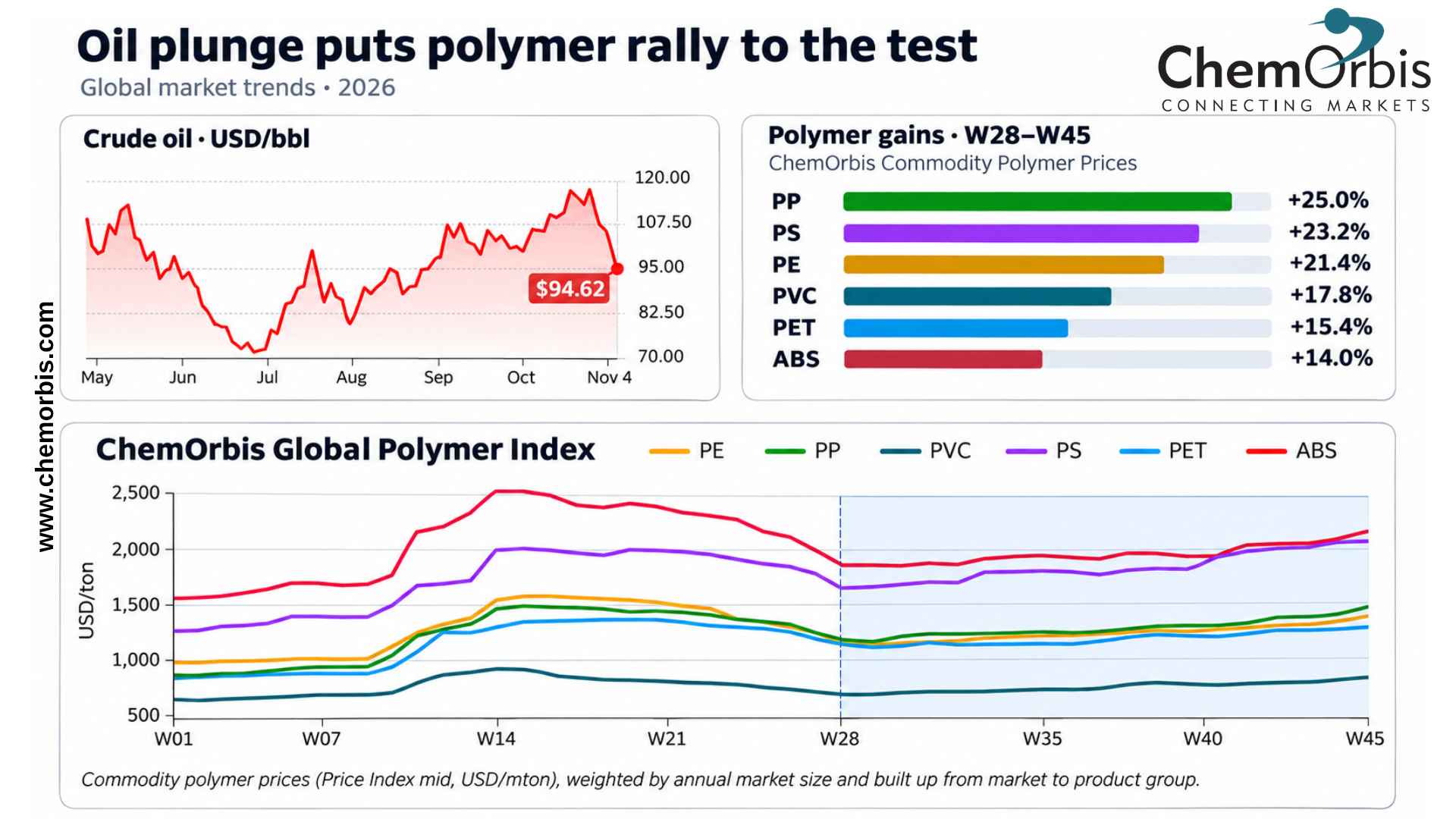
Crude oil prices plunged by nearly 20% in less than a week from the second-highest settlement of $117.64/bbl since the Iran-US war broke out, with much of the decline taking place on Wednesday. Although prices staged a partial recovery on Thursday, they remained near two-month lows below $100/bbl, sending shockwaves through global petrochemical markets. The last time oil experienced a similarly sharp downturn, prices entered a prolonged downward trend that lasted from late April to July.
The recovery in crude oil prices that began in mid-July had also provided support to polymer markets, helping prices regain ground across major product groups. According to the ChemOrbis Global Polymer Index, prices have risen by 14-25% since then, depending on the product, with the upward trend extending into early November.
With fresh price hikes still widely on the agenda for November, however, this week's sudden oil rout has come as a cold shower for polymer markets. The abrupt reversal has raised questions over whether the gains accumulated over the past several months can be sustained, or whether the sharp decline in upstream costs will undermine sellers' confidence in pursuing further increases.
A blow to confidence before prices?
A sharp decline in crude oil does not necessarily translate into an immediate reversal in polymer prices. However, its impact on market sentiment could be much faster. Buyers may become increasingly reluctant to accept further hikes, preferring to wait for clearer signals from upstream markets. This, in turn, could weaken sellers' confidence in pushing for additional increases, even before lower feedstock costs are fully reflected in polymer prices.
Initial market reactions: Asia, Europe and Türkiye
Asia: Oil rout dampens buying appetite despite resilient prices
Across China, Southeast Asia and India, the sharp oil decline has dealt a blow to market confidence, prompting buyers to retreat further to the sidelines amid growing expectations of price corrections. Although polymer prices have largely remained elevated on a weekly basis, supported by constrained supply and previously high feedstock costs, the latest downturn has already triggered some day-on-day discounts, particularly in China. Falling Dalian futures have added to the pressure, while weaker benzene and styrene prices have also begun eroding cost support for styrenics.
In Southeast Asia, PP prices continued to climb to multi-year highs, while PE offers remained largely firm despite mounting buyer resistance. PVC buyers also turned increasingly cautious, fearing a correction from prevailing high levels. Meanwhile, India's import PP and PE rallies stalled as the oil slump compounded pre-Diwali caution.
Across the region, sellers remain reluctant to make substantial concessions amid lingering supply constraints, but buyers are increasingly postponing purchases. Whether the oil decline persists will be crucial in determining if the current standoff gives way to broader price corrections.
Europe: Cost-driven hikes face demand test as oil retreats
European polymer suppliers opened November with fresh hike attempts despite the oil slump, supported by higher monomer settlements, elevated utility costs and margin recovery efforts. Ethylene and propylene contracts rose by €80/ton, prompting PP hike attempts of €80-100/ton and PE targets matching or exceeding the monomer rise. LDPE faced stronger upward pressure amid regional supply disruptions, while uncompetitive imports supported local polyolefin sellers. PVC suppliers sought increases of €90-100/ton to as much as €250/ton, although availability remained comfortable despite Vynova’s temporary production stops.
Styrenics also retained a firm tone despite November styrene settling just €24/ton higher, well below expectations. Total’s ongoing force majeure and limited allocations from some suppliers supported PS hike attempts of €25-55/ton, while a few sources reported triple-digit hike requests from suppliers citing elevated energy costs. Initial ABS increases were generally around €50/ton, reaching €100/ton in some cases depending on October pricing. PET offers rose by €50-70/ton as higher October feedstock settlements, reduced operating rates and limited import competition tightened regional supply.
However, the sharp oil retreat adds uncertainty to sellers’ ability to secure their full targets. Weak downstream demand, October pre-buying and approaching year-end stock reductions have already kept many converters sidelined. Buyers expect smaller increases than initially sought in PP, PE and PVC, while comfortable ABS supply could encourage flexibility. Supply constraints may help PS, LDPE and PET resist immediate downward pressure, but initial hike requests could still be moderated as November negotiations progress.
Türkiye: Oil slump tests supply-driven strength in polymers
Monday’s initial oil plunge of more than 7% barely dented firm polymer sentiment, as limited availability drove higher November targets for polyolefins, PVC and styrenics. Higher European olefin contracts and tight Middle Eastern and Russian spot supply supported PP and PE, while limited availability kept PS and ABS firm despite a smaller-than-expected rise in November styrene. Similarly, tight European and Egyptian volumes underpinned PVC. PET was the sole exception, with import prices retreating from over four-month highs alongside lower Asian feedstock costs.
However, Brent’s further plunge below $95/bbl on Wednesday, marking its lowest settlement since late summer, prompted players to adopt a wait-and-see stance. Initial feedback suggested sellers might moderate hike targets or markets could stabilize if oil remained weak. Some traders ruled out significant discounts in Türkiye regardless of oil’s fall, citing the supply-driven nature of the rally and already low netbacks.
A manufacturer commented, “If falling oil prices slow buying in China and India, PP and PE uptrend could also lose momentum here, with sellers potentially directing cargoes to Türkiye and making concessions toward late November.” Meanwhile, a PS seller corrected offers downward, noting, “Lower oil prices may not immediately reverse the trend, but prices could retreat if the Strait of Hormuz reopens.”
The recovery in crude oil prices that began in mid-July had also provided support to polymer markets, helping prices regain ground across major product groups. According to the ChemOrbis Global Polymer Index, prices have risen by 14-25% since then, depending on the product, with the upward trend extending into early November.
The ChemOrbis Global Polymer Index is the weekly average price of PE, PP, PVC, PS, PET and ABS across markets, in USD/ton, combining ChemOrbis spot price assessments weighted by each market's annual size.“This new tool of ChemOrbis Global Polymer Index will soon be available to all users. Stay tuned!”
With fresh price hikes still widely on the agenda for November, however, this week's sudden oil rout has come as a cold shower for polymer markets. The abrupt reversal has raised questions over whether the gains accumulated over the past several months can be sustained, or whether the sharp decline in upstream costs will undermine sellers' confidence in pursuing further increases.
A blow to confidence before prices?
A sharp decline in crude oil does not necessarily translate into an immediate reversal in polymer prices. However, its impact on market sentiment could be much faster. Buyers may become increasingly reluctant to accept further hikes, preferring to wait for clearer signals from upstream markets. This, in turn, could weaken sellers' confidence in pushing for additional increases, even before lower feedstock costs are fully reflected in polymer prices.
Initial market reactions: Asia, Europe and Türkiye
Asia: Oil rout dampens buying appetite despite resilient prices
Across China, Southeast Asia and India, the sharp oil decline has dealt a blow to market confidence, prompting buyers to retreat further to the sidelines amid growing expectations of price corrections. Although polymer prices have largely remained elevated on a weekly basis, supported by constrained supply and previously high feedstock costs, the latest downturn has already triggered some day-on-day discounts, particularly in China. Falling Dalian futures have added to the pressure, while weaker benzene and styrene prices have also begun eroding cost support for styrenics.
In Southeast Asia, PP prices continued to climb to multi-year highs, while PE offers remained largely firm despite mounting buyer resistance. PVC buyers also turned increasingly cautious, fearing a correction from prevailing high levels. Meanwhile, India's import PP and PE rallies stalled as the oil slump compounded pre-Diwali caution.
Across the region, sellers remain reluctant to make substantial concessions amid lingering supply constraints, but buyers are increasingly postponing purchases. Whether the oil decline persists will be crucial in determining if the current standoff gives way to broader price corrections.
Europe: Cost-driven hikes face demand test as oil retreats
European polymer suppliers opened November with fresh hike attempts despite the oil slump, supported by higher monomer settlements, elevated utility costs and margin recovery efforts. Ethylene and propylene contracts rose by €80/ton, prompting PP hike attempts of €80-100/ton and PE targets matching or exceeding the monomer rise. LDPE faced stronger upward pressure amid regional supply disruptions, while uncompetitive imports supported local polyolefin sellers. PVC suppliers sought increases of €90-100/ton to as much as €250/ton, although availability remained comfortable despite Vynova’s temporary production stops.
Styrenics also retained a firm tone despite November styrene settling just €24/ton higher, well below expectations. Total’s ongoing force majeure and limited allocations from some suppliers supported PS hike attempts of €25-55/ton, while a few sources reported triple-digit hike requests from suppliers citing elevated energy costs. Initial ABS increases were generally around €50/ton, reaching €100/ton in some cases depending on October pricing. PET offers rose by €50-70/ton as higher October feedstock settlements, reduced operating rates and limited import competition tightened regional supply.
However, the sharp oil retreat adds uncertainty to sellers’ ability to secure their full targets. Weak downstream demand, October pre-buying and approaching year-end stock reductions have already kept many converters sidelined. Buyers expect smaller increases than initially sought in PP, PE and PVC, while comfortable ABS supply could encourage flexibility. Supply constraints may help PS, LDPE and PET resist immediate downward pressure, but initial hike requests could still be moderated as November negotiations progress.
Türkiye: Oil slump tests supply-driven strength in polymers
Monday’s initial oil plunge of more than 7% barely dented firm polymer sentiment, as limited availability drove higher November targets for polyolefins, PVC and styrenics. Higher European olefin contracts and tight Middle Eastern and Russian spot supply supported PP and PE, while limited availability kept PS and ABS firm despite a smaller-than-expected rise in November styrene. Similarly, tight European and Egyptian volumes underpinned PVC. PET was the sole exception, with import prices retreating from over four-month highs alongside lower Asian feedstock costs.
However, Brent’s further plunge below $95/bbl on Wednesday, marking its lowest settlement since late summer, prompted players to adopt a wait-and-see stance. Initial feedback suggested sellers might moderate hike targets or markets could stabilize if oil remained weak. Some traders ruled out significant discounts in Türkiye regardless of oil’s fall, citing the supply-driven nature of the rally and already low netbacks.
A manufacturer commented, “If falling oil prices slow buying in China and India, PP and PE uptrend could also lose momentum here, with sellers potentially directing cargoes to Türkiye and making concessions toward late November.” Meanwhile, a PS seller corrected offers downward, noting, “Lower oil prices may not immediately reverse the trend, but prices could retreat if the Strait of Hormuz reopens.”