
After Germany and the Netherlands, Vynova files for bankruptcy in Belgium: Where do its remaining European operations stand?
Free EDC
Vynova’s bankruptcy filing in Belgium marks another setback for the European PVC and chlor-alkali producer, following insolvency proceedings in Germany, plant shutdowns and asset sales. Despite restructuring efforts, proposed government-backed financing and talks with potential buyers, the company has failed to secure a sustainable solution. With some assets sold and others facing an uncertain future, what remains of its European operations?
Vynova Belgium NV filed for bankruptcy on November 10, 2026, after months of unsuccessful negotiations with potential investors. The filing follows the insolvency of its German subsidiary, Vynova Wilhelmshaven, in December 2025 and a series of production shutdowns across Europe.
High energy costs, weak PVC demand and growing competition from lower-cost imports have weighed on the group’s operations. While Vynova has sold assets in Germany and the UK, the future of its integrated production network in Belgium, the Netherlands and France remains uncertain.
From financial difficulties to bankruptcy
Vynova’s troubles intensified in 2025, when it announced plans to close its 225,000 tons/year Beek PVC plant in the Netherlands. Production stopped in November, followed by insolvency proceedings at its Wilhelmshaven subsidiary in Germany in December. Vynova Belgium subsequently entered judicial reorganisation on December 26, seeking creditor protection while exploring financing and acquisition options.
According to Flemish Minister-President Matthias Diependaele, Vynova had been loss-making for several years before its shareholders stopped covering its losses in late 2025. This triggered a liquidity crisis, forcing the company to seek alternative funding. Diependaele cited declining European PVC demand, global overcapacity and high energy and feedstock costs as key challenges.
Vynova Belgium’s creditor protection was extended until December 26, 2026, with a restructuring plan scheduled for a creditor vote on December 4. However, the company filed for bankruptcy before reaching those deadlines.
Rescue efforts fail despite financial support initiatives
In June 2026, the Flemish government approved a proposed financing arrangement involving a credit facility of up to €52 million to support Vynova’s restructuring. However, Diependaele clarified on November 10 that the associated government guarantee never took effect because the required European Commission approval had not been obtained.
Vynova had previously received support to offset high electricity costs, including around €20 million in indirect carbon leakage compensation relating to 2023. Nevertheless, the company continued to struggle with structural cost pressures and reportedly accumulated debts of approximately €275 million.
Efforts to find a buyer also failed. According to Belgian broadcaster TVL, Dutch chemical producer Nobian was among the potential acquirers but withdrew from the process. With no recapitalisation or acquisition agreement secured, Vynova Belgium filed for bankruptcy, with a court ruling expected in the coming days.
Where do Vynova’s European operations stand?
What’s left of Vynova’s European PVC business?
The developments have significantly reduced Vynova’s European footprint. Wilhelmshaven and Runcorn have passed to new owners, while Tessenderlo faces bankruptcy proceedings, Beek remains financially distressed and Mazingarbe’s future is tied to upstream VCM supplies.
The situation also highlights the vulnerability of integrated PVC production chains. Tessenderlo’s role as a VCM supplier means disruptions in Belgium can directly affect downstream production in the Netherlands and France.
With restructuring efforts exhausted and no buyer secured for its remaining integrated operations, Vynova’s future remains uncertain. Its difficulties also reflect wider pressures on Europe’s energy-intensive chemical industry, where high costs, weak demand and import competition continue to challenge producers.
Vynova Belgium NV filed for bankruptcy on November 10, 2026, after months of unsuccessful negotiations with potential investors. The filing follows the insolvency of its German subsidiary, Vynova Wilhelmshaven, in December 2025 and a series of production shutdowns across Europe.
High energy costs, weak PVC demand and growing competition from lower-cost imports have weighed on the group’s operations. While Vynova has sold assets in Germany and the UK, the future of its integrated production network in Belgium, the Netherlands and France remains uncertain.
From financial difficulties to bankruptcy
Vynova’s troubles intensified in 2025, when it announced plans to close its 225,000 tons/year Beek PVC plant in the Netherlands. Production stopped in November, followed by insolvency proceedings at its Wilhelmshaven subsidiary in Germany in December. Vynova Belgium subsequently entered judicial reorganisation on December 26, seeking creditor protection while exploring financing and acquisition options.
According to Flemish Minister-President Matthias Diependaele, Vynova had been loss-making for several years before its shareholders stopped covering its losses in late 2025. This triggered a liquidity crisis, forcing the company to seek alternative funding. Diependaele cited declining European PVC demand, global overcapacity and high energy and feedstock costs as key challenges.
Vynova Belgium’s creditor protection was extended until December 26, 2026, with a restructuring plan scheduled for a creditor vote on December 4. However, the company filed for bankruptcy before reaching those deadlines.
Rescue efforts fail despite financial support initiatives
In June 2026, the Flemish government approved a proposed financing arrangement involving a credit facility of up to €52 million to support Vynova’s restructuring. However, Diependaele clarified on November 10 that the associated government guarantee never took effect because the required European Commission approval had not been obtained.
Vynova had previously received support to offset high electricity costs, including around €20 million in indirect carbon leakage compensation relating to 2023. Nevertheless, the company continued to struggle with structural cost pressures and reportedly accumulated debts of approximately €275 million.
Efforts to find a buyer also failed. According to Belgian broadcaster TVL, Dutch chemical producer Nobian was among the potential acquirers but withdrew from the process. With no recapitalisation or acquisition agreement secured, Vynova Belgium filed for bankruptcy, with a court ruling expected in the coming days.
Where do Vynova’s European operations stand?
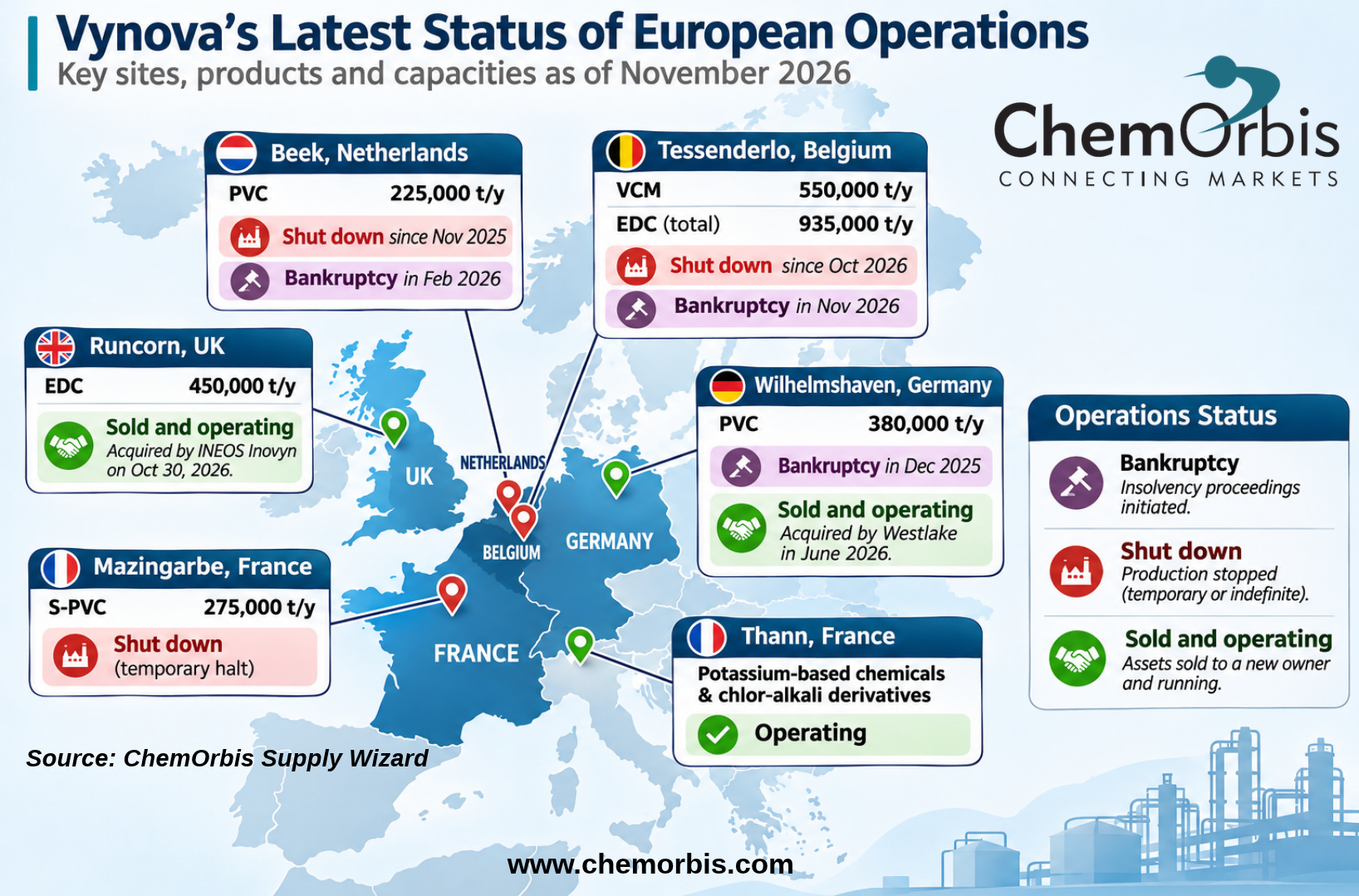
- Belgium – Tessenderlo: Vynova began winding down production at its Tessenderlo-Ham site in late October to preserve cash amid high energy costs. The shutdown covered caustic soda, potassium hydroxide and VCM production. Although the facilities were initially to be maintained in a restart-ready condition, the bankruptcy filing has raised further uncertainty.
- Netherlands – Beek: The 225,000 tons/year PVC plant stopped production in November 2025, while its original operator subsequently entered insolvency proceedings , and the assets were transferred to LVM Netherlands, a subsidiary of Vynova Belgium, which is overseeing their potential restart. Although there were plans back in May to restart the Beek PVC plant at the Chemelot industrial site in October aimed at stabilizing operations ahead of a potential transfer to a new investor, the planned restart under LVM Netherlands BV was suspended in late October. On November 10, the company announced that LVM was applying for suspension of payments.
- France – Mazingarbe: Vynova also announced plans to temporarily halt PVC production at Mazingarbe, which depends on VCM supplies from Tessenderlo. Following the Belgian bankruptcy filing, the company said it was assessing the impact on its French subsidiary. No permanent closure has been announced.
- Germany – Wilhelmshaven: Following insolvency proceedings in December 2025, the PVC and VCM site was acquired by Westlake in June 2026. The transaction included 380,000 tons/year of PVC capacity, which remains in the European market under new ownership.
- UK – Runcorn: INEOS Inovyn completed its acquisition of Vynova’s EDC assets and remaining 50% stake in Runcorn MCP Limited on October 30, 2026.
What’s left of Vynova’s European PVC business?
The developments have significantly reduced Vynova’s European footprint. Wilhelmshaven and Runcorn have passed to new owners, while Tessenderlo faces bankruptcy proceedings, Beek remains financially distressed and Mazingarbe’s future is tied to upstream VCM supplies.
The situation also highlights the vulnerability of integrated PVC production chains. Tessenderlo’s role as a VCM supplier means disruptions in Belgium can directly affect downstream production in the Netherlands and France.
With restructuring efforts exhausted and no buyer secured for its remaining integrated operations, Vynova’s future remains uncertain. Its difficulties also reflect wider pressures on Europe’s energy-intensive chemical industry, where high costs, weak demand and import competition continue to challenge producers.