

S Korea's Shaheen project readies for start-up as Ulsan restructuring stalls, 2027 outlook dims
Free Ethylene

S-Oil's Shaheen Project in Ulsan is set to hold its completion ceremony on November 25, while South Korea's petrochemical restructuring remains stuck in the same complex. The latest industry outlook adds to the pressure, with petrochemical exports expected to decline next year amid lower feedstock costs and persistent Chinese oversupply.
Shaheen nears start-up
The Shaheen Project cost around 9 trillion won (approximately $6.7 billion) and will add 1.8 million tons/year of ethylene capacity. Since it includes processes and equipment deployed for the first time globally, full-scale operation with actual feedstock is not expected until early 2027.
Ulsan remains the missing piece
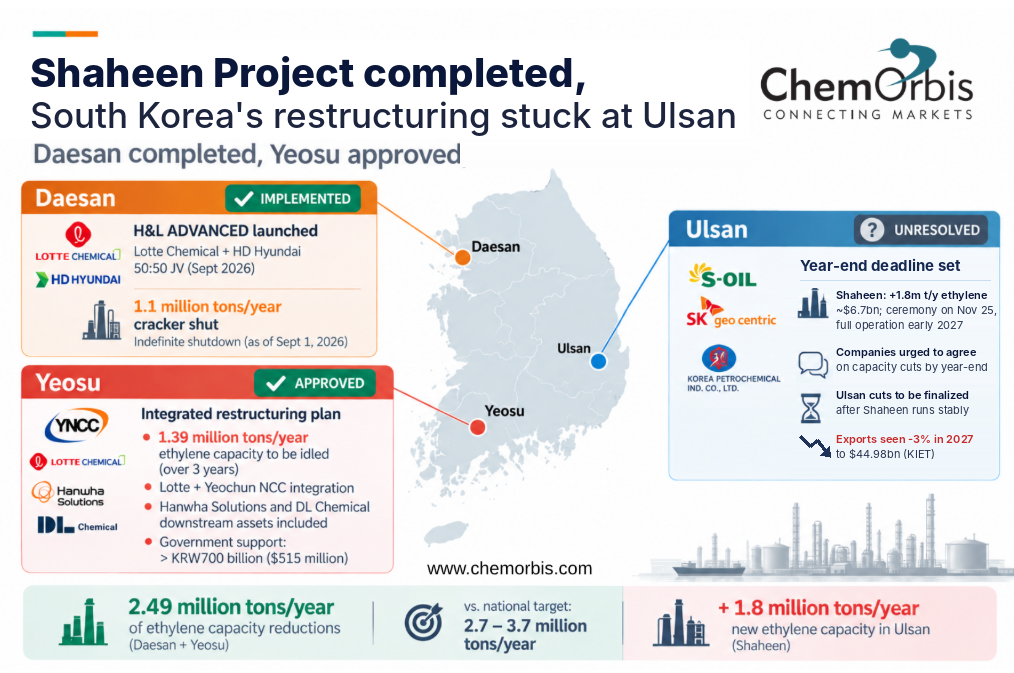
The government has set a year-end deadline for petrochemical restructuring, with Industry Minister Kim Jung-kwan urging companies to share responsibility for the sector's future and conclude talks this year. Sixteen companies have submitted restructuring plans so far, and plans for Daesan and Yeosu were approved in February and July, respectively. Together they cover 1.1 million tons of capacity at Daesan and 1.39 million tons at Yeosu.
In Ulsan, however, restructuring talks remain stalled, with S-Oil, SK Geo Centric and Korea Petrochemical Ind still at odds over the scale and location of production cuts. The ministry said it will first confirm the stable operation of the Shaheen Project before finalizing cuts in Ulsan. A ministry official noted that Ulsan lags other complexes by about five years and that a plan must be ready within the year so it can be implemented once Shaheen runs at full capacity.
2027 outlook not promising
KIET's 2027 Economic and Industrial Outlook report forecasts South Korea's petrochemical exports at $44.98 billion next year, down 3% from 2026. This year's exports are expected to reach $46.37 billion, up 9% year-on-year, as higher unit prices offset a 9.9% decline in volumes. This price boost came from higher feedstock costs after the Strait of Hormuz blockade disrupted supplies, and it is expected to fade as crude and naphtha prices ease next year.
China's capacity expansions are also reducing demand for South Korean commodity grades, while surplus Chinese material flowing into third markets and into South Korea could weigh on both exports and domestic sales. The Middle East remains the key variable: a reopening of the Strait of Hormuz could support utilization rates and export volumes, while a prolonged blockade would extend export constraints.
Shaheen nears start-up
The Shaheen Project cost around 9 trillion won (approximately $6.7 billion) and will add 1.8 million tons/year of ethylene capacity. Since it includes processes and equipment deployed for the first time globally, full-scale operation with actual feedstock is not expected until early 2027.
Ulsan remains the missing piece
The government has set a year-end deadline for petrochemical restructuring, with Industry Minister Kim Jung-kwan urging companies to share responsibility for the sector's future and conclude talks this year. Sixteen companies have submitted restructuring plans so far, and plans for Daesan and Yeosu were approved in February and July, respectively. Together they cover 1.1 million tons of capacity at Daesan and 1.39 million tons at Yeosu.
In Ulsan, however, restructuring talks remain stalled, with S-Oil, SK Geo Centric and Korea Petrochemical Ind still at odds over the scale and location of production cuts. The ministry said it will first confirm the stable operation of the Shaheen Project before finalizing cuts in Ulsan. A ministry official noted that Ulsan lags other complexes by about five years and that a plan must be ready within the year so it can be implemented once Shaheen runs at full capacity.
According to the Korea Institute for Industrial Economics & Trade (KIET), capacity lost to restructuring is still expected to exceed Shaheen's new additions.
2027 outlook not promising
KIET's 2027 Economic and Industrial Outlook report forecasts South Korea's petrochemical exports at $44.98 billion next year, down 3% from 2026. This year's exports are expected to reach $46.37 billion, up 9% year-on-year, as higher unit prices offset a 9.9% decline in volumes. This price boost came from higher feedstock costs after the Strait of Hormuz blockade disrupted supplies, and it is expected to fade as crude and naphtha prices ease next year.
China's capacity expansions are also reducing demand for South Korean commodity grades, while surplus Chinese material flowing into third markets and into South Korea could weigh on both exports and domestic sales. The Middle East remains the key variable: a reopening of the Strait of Hormuz could support utilization rates and export volumes, while a prolonged blockade would extend export constraints.