

EU plastic waste export ban: A market for recyclates, or more pressure on Türkiye?
The EU's ban on plastic waste exports to non-OECD countries took effect on November 21, closing outlets that took around 670,000 tonnes in 2025. Recyclers ask whether this will finally create a market for recycled plastics in Europe. With demand still weak and recycling capacity shrinking, however, much of this lower-quality material risks being incinerated or landfilled instead. For Türkiye, already the largest destination for EU plastic waste, the ban means continued access to feedstock, but under tighter scrutiny.
Around 670,000 tonnes now need new outlets
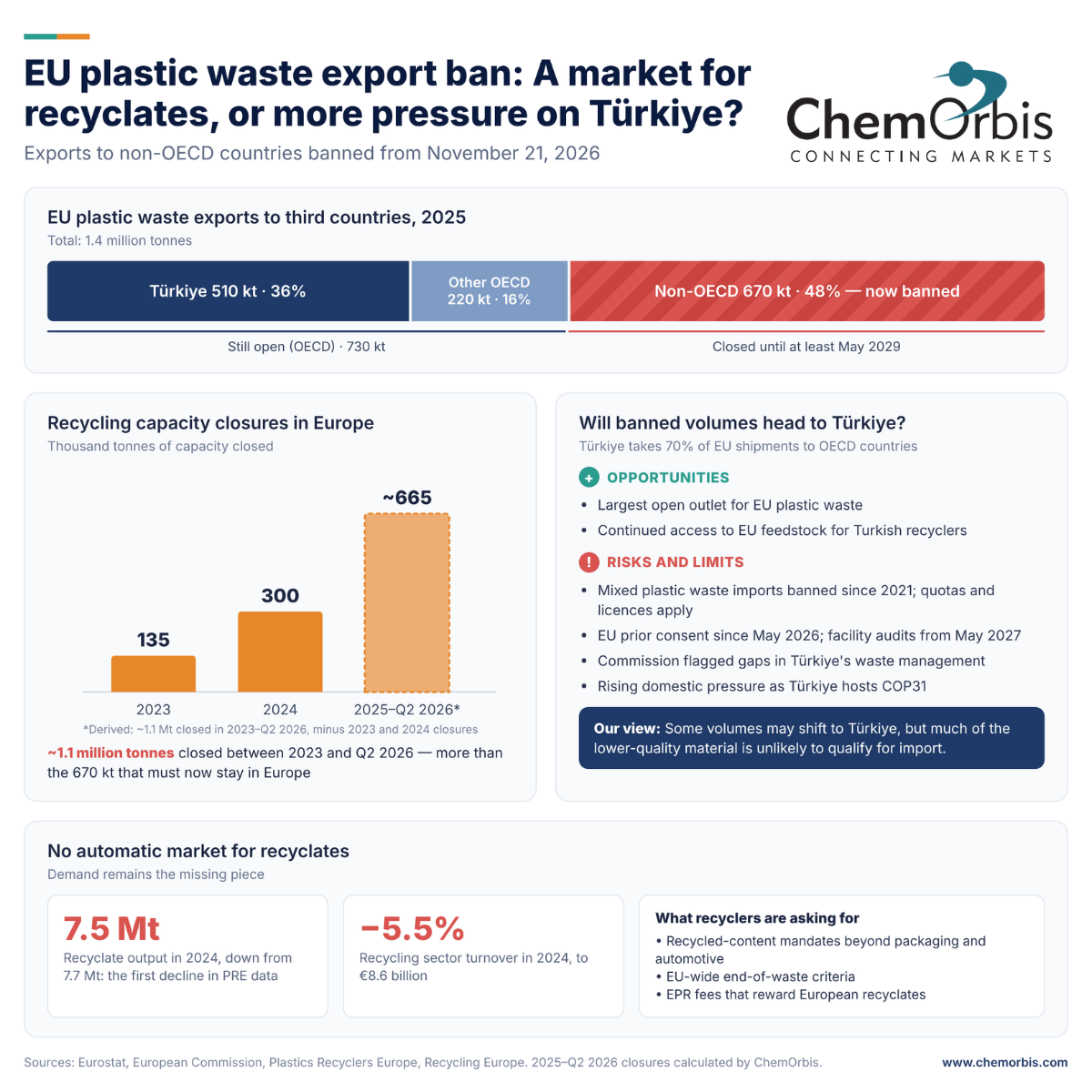
According to the European Commission, the EU generates around 40 million tonnes of plastic waste a year. Based on Eurostat trade data, the EU exported 1.4 million tonnes of plastic waste to third countries in 2025. Of this, 730,000 tonnes went to OECD countries, while the remaining 670,000 tonnes went to non-OECD destinations, which are now closed until at least May 2029. After that date, non-OECD countries may request an exemption from the ban, subject to a Commission assessment of their treatment capacity.
Exports account for only a small share of the EU's total plastic waste, but they typically consist of lower-quality material that is harder to recycle economically in Europe.
Recycling base shrinks after years of closures
The additional volumes arrive at a sector under strain. According to the latest annual report from Plastics Recyclers Europe (PRE), published in November 2025, installed plastics recycling capacity in Europe stood at 13.5 million tonnes in 2024. Recyclate output declined from 7.7 million tonnes to around 7.5 million tonnes, and the sector's turnover fell 5.5% to €8.6 billion. PRE says capacity growth remains well below the 6% a year needed to meet the targets of the Packaging and Packaging Waste Regulation (PPWR).
Plant closures have also accelerated. About 300,000 tonnes of capacity shut in 2024, compared with 135,000 tonnes in 2023, with polyolefin films and PET each accounting for around a quarter of the closures. More recent PRE data, cited in a September letter from plastics value chain organisations to the European Commission, show that recyclers representing around 1.1 million tonnes of capacity closed between 2023 and the second quarter of 2026. That is more than the volumes now expected to stay in Europe. PRE links the downturn to high energy and production costs, weak demand and growing volumes of low-priced imports.
No automatic market for recyclates
Recycling Europe argues that keeping waste in Europe will only support recycling if demand for recyclates rises at the same time. Without it, the association warns, the ban risks diverting material to incineration and landfill. It is calling for mandatory recycled-content requirements to be extended beyond packaging and automotive, harmonised EU-wide end-of-waste criteria, and EPR fees eco-modulated to reward the use of European recycled plastics. It also wants DIWASS, the EU's digital waste shipment system, fixed so that it facilitates recycling rather than creating new obstacles. PRE and other value chain organisations have also called for closing loopholes in verification and enforcement to ensure a level playing field with imports.
What it means for Türkiye
As an OECD member, Türkiye is not covered by the ban. In 2025 it received 510,000 tonnes of EU plastic waste, or 36% of the bloc's total plastic waste exports and 70% of shipments to OECD countries. The Commission notes that the ban could shift export flows towards OECD countries.
However, much of the material losing its non-OECD outlets is unlikely to find its way to Türkiye. Türkiye has banned imports of mixed plastic waste since 2021, and the waste types it does allow are subject to annual communiqués, compliance checks, facility certification and quotas.
Conditions on the EU side are also tightening. Since May 21, 2026, plastic waste exports to OECD countries have required prior notification and consent. From May 2027, EU exporters will also have to ensure that receiving facilities have passed independent audits confirming that they operate in an environmentally sound manner. The Commission can suspend shipments if it finds a risk of environmental harm. In its assessment published in September, it did not halt shipments to Türkiye. It did, however, identify gaps in Türkiye's waste management and said it would continue to monitor EU plastic waste exports to the country.
The issue is also drawing more attention at home. Türkiye hosted the COP31 climate summit in Antalya earlier this month, where it has put zero waste on the agenda, and Greenpeace Türkiye has launched a campaign calling for a full ban on plastic and textile waste imports. For Turkish recyclers, this means EU feedstock should remain available, but with higher compliance costs and greater regulatory risk.
Around 670,000 tonnes now need new outlets
According to the European Commission, the EU generates around 40 million tonnes of plastic waste a year. Based on Eurostat trade data, the EU exported 1.4 million tonnes of plastic waste to third countries in 2025. Of this, 730,000 tonnes went to OECD countries, while the remaining 670,000 tonnes went to non-OECD destinations, which are now closed until at least May 2029. After that date, non-OECD countries may request an exemption from the ban, subject to a Commission assessment of their treatment capacity.
Exports account for only a small share of the EU's total plastic waste, but they typically consist of lower-quality material that is harder to recycle economically in Europe.
Recycling base shrinks after years of closures
The additional volumes arrive at a sector under strain. According to the latest annual report from Plastics Recyclers Europe (PRE), published in November 2025, installed plastics recycling capacity in Europe stood at 13.5 million tonnes in 2024. Recyclate output declined from 7.7 million tonnes to around 7.5 million tonnes, and the sector's turnover fell 5.5% to €8.6 billion. PRE says capacity growth remains well below the 6% a year needed to meet the targets of the Packaging and Packaging Waste Regulation (PPWR).
Plant closures have also accelerated. About 300,000 tonnes of capacity shut in 2024, compared with 135,000 tonnes in 2023, with polyolefin films and PET each accounting for around a quarter of the closures. More recent PRE data, cited in a September letter from plastics value chain organisations to the European Commission, show that recyclers representing around 1.1 million tonnes of capacity closed between 2023 and the second quarter of 2026. That is more than the volumes now expected to stay in Europe. PRE links the downturn to high energy and production costs, weak demand and growing volumes of low-priced imports.
No automatic market for recyclates
Recycling Europe argues that keeping waste in Europe will only support recycling if demand for recyclates rises at the same time. Without it, the association warns, the ban risks diverting material to incineration and landfill. It is calling for mandatory recycled-content requirements to be extended beyond packaging and automotive, harmonised EU-wide end-of-waste criteria, and EPR fees eco-modulated to reward the use of European recycled plastics. It also wants DIWASS, the EU's digital waste shipment system, fixed so that it facilitates recycling rather than creating new obstacles. PRE and other value chain organisations have also called for closing loopholes in verification and enforcement to ensure a level playing field with imports.
What it means for Türkiye
As an OECD member, Türkiye is not covered by the ban. In 2025 it received 510,000 tonnes of EU plastic waste, or 36% of the bloc's total plastic waste exports and 70% of shipments to OECD countries. The Commission notes that the ban could shift export flows towards OECD countries.
However, much of the material losing its non-OECD outlets is unlikely to find its way to Türkiye. Türkiye has banned imports of mixed plastic waste since 2021, and the waste types it does allow are subject to annual communiqués, compliance checks, facility certification and quotas.
Conditions on the EU side are also tightening. Since May 21, 2026, plastic waste exports to OECD countries have required prior notification and consent. From May 2027, EU exporters will also have to ensure that receiving facilities have passed independent audits confirming that they operate in an environmentally sound manner. The Commission can suspend shipments if it finds a risk of environmental harm. In its assessment published in September, it did not halt shipments to Türkiye. It did, however, identify gaps in Türkiye's waste management and said it would continue to monitor EU plastic waste exports to the country.
The issue is also drawing more attention at home. Türkiye hosted the COP31 climate summit in Antalya earlier this month, where it has put zero waste on the agenda, and Greenpeace Türkiye has launched a campaign calling for a full ban on plastic and textile waste imports. For Turkish recyclers, this means EU feedstock should remain available, but with higher compliance costs and greater regulatory risk.